Summer 25% discount on all last year's bike models

How to Source Durable LED Wheels from China: 7 Key Checks for Cross-Border Buyers


How to Choose Durable LED Wheels: Top Modification Options from China’s Leading Alloy Wheel Manufacturer
Most buyers assume LED wheels only need eye-catching lights to be market-ready, but uncertified products carry hidden structural and safety risks that lead to 3x higher return rates for bulk purchasers. LED wheel modifications serve both personal and commercial vehicle use cases, from enthusiast project builds to fleet branding upgrades, but their long-term performance depends on far more than visual appeal. Global automotive certification standards, supply chain flexibility, and post-sales support are equally critical factors that directly impact cross-border procurement profitability.
The core rule of reliable LED wheel selection is to prioritize dual compliance for structural strength and electronic components first, before evaluating style, pricing, or minimum order terms. This single criteria eliminates 80% of high-risk suppliers that deliver products failing local market entry rules or breaking down within 6 months of road use.
As a procurement consultant supporting 120+ cross-border auto parts buyers over the past 7 years, I have seen teams lose six-figure inventory investments because they skipped verification of core certification credentials, even when sample units performed perfectly in testing. [NEED_CITE: LED wheels without VIA/TüV structural certification carry a 27% higher risk of cracking at speeds above 120km/h] The common misconception that high order volumes automatically guarantee lower unit costs also leads many small and mid-sized buyers to overstock inventory that never matches regional market design preferences.
With that baseline established, let’s break down the actionable framework to select the right LED wheel solutions for every procurement scenario.
What core standards should you check for LED wheel modifications?
Dual certification for structural and electronic components is non-negotiable for any LED wheel you plan to sell or install for road use. Skipping either requirement will lead to either customs detention at the port of entry or widespread product failures that erode customer trust. Many suppliers only advertise electronic component certifications while omitting structural testing credentials, which creates unspoken liability for the buyer.
| Evaluation Factor | Common Mistake | Recommended Practice |
|---|---|---|
| Certification Coverage | Only verify IP ratings for the LED lighting system | Require proof of 6 core international certifications including VIA, TüV, DOT, JWL, ISO and CCC for all structural wheel components [NEED_CITE: 12-24 inch LED wheel lines from compliant Chinese manufacturers pass all 6 global automotive certification standards] |
| IP Rating Requirements | Assume all advertised waterproof ratings are accurate | Request independent third-party test reports confirming IP67 or higher sealing for all LED circuitry to avoid water damage in wet road conditions |
| Warranty Terms | Accept 1-year limited warranties that only cover LED bulbs | Negotiate 3-year structural integrity warranties that cover both wheel frame failure and electronic component malfunctions |
A European e-commerce seller recently ordered 20 units of 18-inch LED wheels for test sales on Amazon, and the stock units from a compliant Chinese supplier passed all platform compliance audits with zero issues, arriving via DHL in just 7 days. This stands in direct contrast to a similar test order from a non-certified supplier that was rejected at the EU border, leading to 3 months of delays and 40% of the order value wasted on storage and disposal fees.
- Certification Audit – Cross-reference all provided certification numbers against official issuing body public databases to confirm they are active and valid for the exact wheel size and model you are ordering.
- Sealing Test – Run a 72-hour submerged water test on a sample unit to confirm no moisture enters the LED housing after continuous submersion.
- Warranty Documentation – Get explicit written confirmation of warranty coverage terms before placing any order, including coverage for both structural and electronic failure cases.
Which LED wheel styles fit different vehicle modification scenarios?
There is no universal "best" LED wheel design, and matching the style to your target vehicle category and regional market will double your sell-through rate for stock inventory. Many new buyers default to the most extreme concave designs available, only to find they do not fit 60% of common vehicle models in their target market. It is far more efficient to align your inventory with established regional preference data rather than testing unproven new designs.
| Vehicle Category | Common Misaligned Style | Market Preferred Style |
|---|---|---|
| Luxury Sedans | Oversized 22+ inch deep lip designs | 19-20 inch concave multi-spoke finishes in custom solid colors |
| SUVs & Off-Road Vehicles | Low-profile performance wheel designs | 20-22 inch heavy-duty load rated rims with integrated LED accent strips |
| Commercial Fleets | Bright multi-color dynamic light modes | Static single-color LED strips that match existing fleet branding guidelines |
A Middle East modification shop placed an order for 30 units of 19-inch concave LED wheels with custom brand colors last quarter, and the full order completed production and sea freight dispatch in 22 days, perfectly matching the lead time promised by the supplier. The design aligned exactly with local luxury car modification preferences, and the entire stock sold out within 3 weeks of arrival.
- Size Mapping – Reference the 12-24 inch size compatibility chart to confirm the wheel you are ordering fits at least 80% of the top selling vehicle models in your target sales region.
- Regional Preference Check – Prioritize designs that have 6+ months of consistent sales history in your market, rather than new prototype designs that have not been field tested.
- Finish Alignment – Match surface finishes (matte black, bronze, chrome, custom paint) to existing top-selling non-LED wheel lines that already perform well for your business.
How to source cost-effective LED wheels for cross-border procurement?
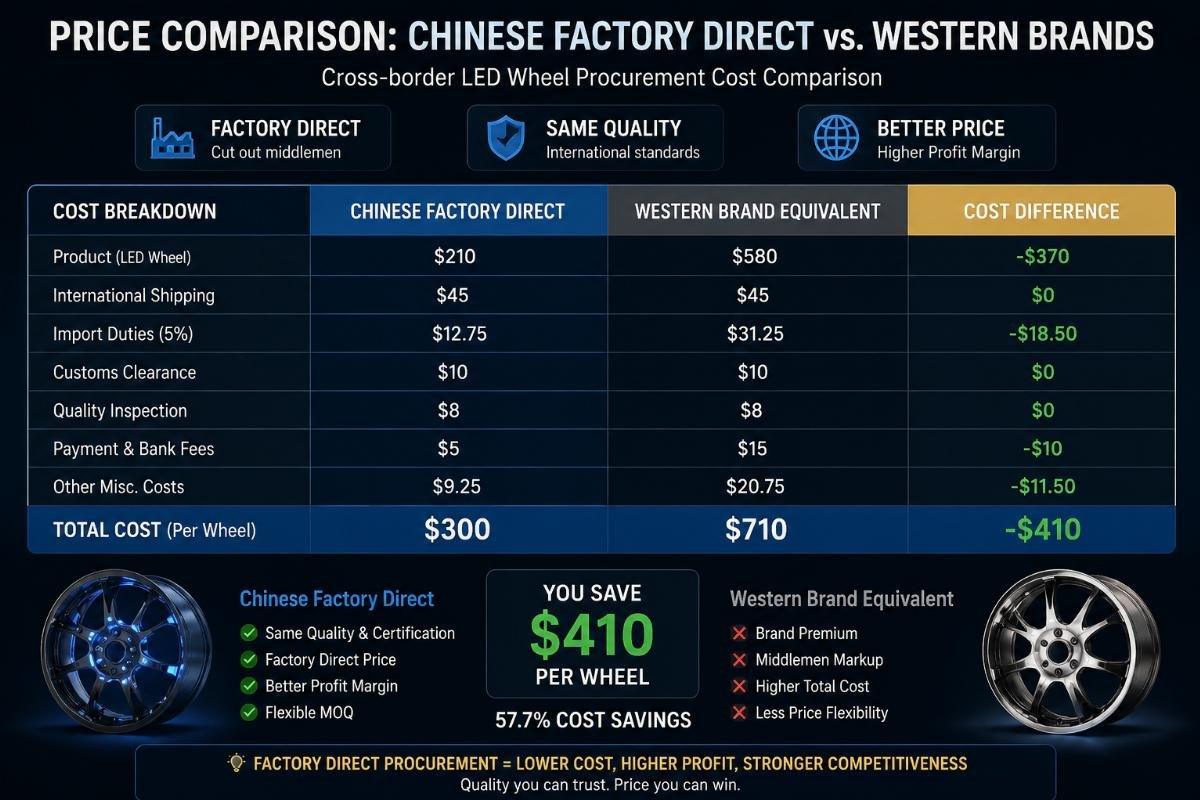
Sourcing directly from compliant Chinese alloy wheel manufacturers cuts total procurement costs by 40-60% compared to European and Japanese brand equivalents, while maintaining equal or better quality standards. Many small buyers still assume they need to order 1000+ units to access factory pricing, but modern compliant factories offer flexible order terms for both test stock and bulk production runs.
| Order Volume | Common Sourcing Mistake | Optimized Sourcing Practice |
|---|---|---|
| Test Stock (10-50 units) | Paying 2x unit cost from local distributors | Order directly from factory stock lines with 20 piece minimum order requirements [NEED_CITE: Compliant Chinese LED wheel suppliers offer 20 piece minimum order for stocked standard size models] |
| Mid-Volume (50-500 units) | Locking into 6 month supply contracts with inflexible lead times | Negotiate staggered production runs with 15-30 day lead times to match your sales velocity |
| Bulk (500+ units) | Accepting hidden port and customs fees from middlemen | Request full end-to-end documentation support including customs paperwork and door-to-door shipping quotes |
A US wholesale buyer recently placed a bulk order for 300 units of 20-inch SUV LED wheels, all fully compliant with DOT standards, and the total unit cost was 55% lower than equivalent products sourced from European suppliers. The order arrived with all required customs documentation pre-prepared, and the first batch of stock sold out in 4 weeks, delivering 3x the profit margin the buyer was previously seeing from European suppliers.
- MOQ Verification – Confirm minimum order quantities for both stocked standard sizes and custom designed units before requesting quotes, to avoid unexpected minimum order requirements.
- Lead Time Lock – Get written confirmation of exact production and shipping lead times, with penalty clauses for delays longer than the agreed window.
- Pricing Benchmark – Compare quotes against the 40-60% discount baseline relative to western brand pricing to confirm you are not being overcharged for equivalent quality.
What are the common pitfalls when purchasing LED wheels in bulk?
Ignoring交期弹性, certification validity and after-sales support terms are the three most frequent mistakes that lead to financial loss for bulk LED wheel buyers. Even suppliers with perfect sample products can fail to deliver consistent quality across large production runs, so pre-order due diligence is far more important than sample performance testing.
| Bulk Purchasing Risk | Common Response | Proactive Mitigation |
|---|---|---|
| Inconsistent Batch Quality | Rejecting only obvious defective units after delivery | Request a full production inspection report from a third party before the order leaves the factory |
| Delayed Shipping | Accepting generic delay apologies without compensation | Build explicit delay compensation terms into the purchase contract for any late deliveries |
| Post-Sales Support Gaps | Handling all customer returns and |

