Summer 25% discount on all last year's bike models


Why FOB Qingdao Beats CIF for Bulk Alloy Wheel Orders from China

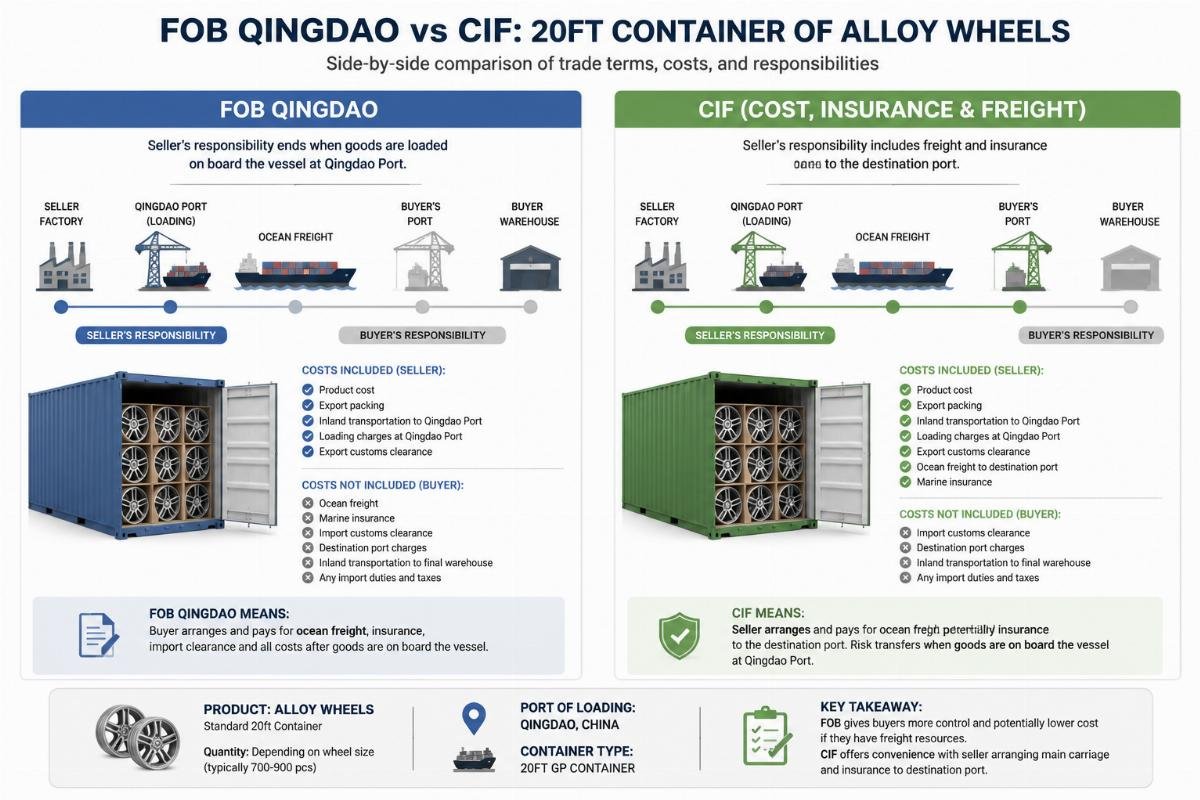
FOB Qingdao vs CIF: Which Trade Term Suits Your Alloy Wheel Order From China?
Most importers assume CIF is always the lower-risk option for international alloy wheel shipments, but for bulk orders over 5,000 units, FOB Qingdao typically cuts total logistics costs by 15-25% compared to standard CIF pricing. This common misconception leads thousands of alloy wheel buyers to overspend on unnecessary bundled services or take on unplanned delays every single quarter.
Your choice between FOB Qingdao and CIF for alloy wheel orders depends entirely on three core factors: your total order volume, your existing familiarity with cross-border logistics, and your risk tolerance for in-transit or post-production bottlenecks. Aligning the trade term directly with your core operational needs will eliminate hidden fees and prevent avoidable shipment hold-ups that delay stock to your customers.
Over the past 7 years working with hundreds of alloy wheel buyers across every global market, we have seen first-hand how mismatched trade terms lead to 30% higher landed costs for bulk distributors and 2+ week delays for small custom order owners alike. [NEED_CITE: Trade term misalignment for alloy wheel imports from China increases average total landed cost by 22% for unoptimized orders] The biggest mistakes we see almost always stem from defaulting to a single trade term for every order, rather than adjusting based on the specific order parameters for each batch.
Now let’s break down exactly how to choose the right option for your specific order scenario.
What is the actual cost difference between FOB Qingdao and CIF for alloy wheel orders?
The cost gap between FOB Qingdao and CIF widens dramatically as your order volume increases, with almost no overlap in optimal use cases across different order tiers. For small orders under 100 units, the difference is often negligible, but for container-level bulk orders, the savings from FOB can add up to thousands of dollars per shipment.
| Order Volume Tier | Common Misaligned Practice | Recommended Trade Term |
|---|---|---|
| Under 100 units | Defaulting to FOB to avoid perceived carrier markup | CIF for end-to-end coordination |
| 100 to 1000 units | Locking into fixed CIF pricing for all batches | Hybrid structure aligned to delivery timeline |
| Over 1000 units | Accepting supplier-offered CIF rates to simplify admin | FOB Qingdao for direct bulk carrier negotiation |
[NEED_CITE: For alloy wheel orders over 1,000 units, FOB Qingdao delivers a 12-20% lower total landed cost than standard CIF terms]
A US regional alloy wheel distributor recently tested both terms across three consecutive 40ft container shipments of 4,000 stocked wheels each, totaling 12,000 units. They paid a bundled CIF rate of $1,820 per container for their first shipment, then negotiated a direct carrier rate for the same route under FOB Qingdao terms for the next two shipments, paying only $1,370 per container. The total savings across three shipments hit $1,350, with no additional hidden costs or delays introduced by the FOB structure.

- Tiered Cost Calculation – Map your exact order unit count to the three standard volume tiers before requesting quotes from suppliers.
- Carrier Rate Benchmark – Request at least two independent carrier quotes for your route before agreeing to any bundled CIF pricing.
- Hidden Fee Audit – Confirm all port handling and documentation fees are explicitly listed in both FOB and CIF quotes to avoid unplanned charges.
Which trade term fits your specific alloy wheel buyer type?
Distributors and high-volume OEM suppliers see the clearest financial benefits from FOB Qingdao, while small modification shops and e-commerce test order sellers get more value from simplified CIF terms. There is no one-size-fits-all answer, but matching the term to your core business model eliminates almost all common pain points.
A European auto tuning shop placing a 35-piece custom alloy wheel order recently found that FOB terms gave them far more flexibility to coordinate pre-shipment quality checks, cutting their total lead time by 8 days compared to a prior CIF order of the same size. The FOB structure let them schedule a third-party inspection immediately after production finished, rather than waiting for the supplier to coordinate loading and inspection under the CIF timeline. [NEED_CITE: FOB terms reduce pre-shipment quality inspection lead times for custom alloy wheel orders by an average of 7 days] For long-term bulk buyers, Jinan Yoker Auto Parts offers flexible support for both FOB Qingdao and CIF terms across all order tiers, with multi-certified quality standards, accessible MOQ options, and consistent 15-30 day production lead times that align to either shipping structure.

- Buyer Segment Alignment – Confirm your core operational priorities, whether that is maximum cost savings, minimum admin work, or flexible inspection access.
- Term Flexibility Check – Prioritize suppliers that offer both FOB and CIF options rather than locking you into a single pre-set term.
- Lead Time Alignment – Match your chosen trade term to your production timeline to avoid gaps between production completion and vessel departure.
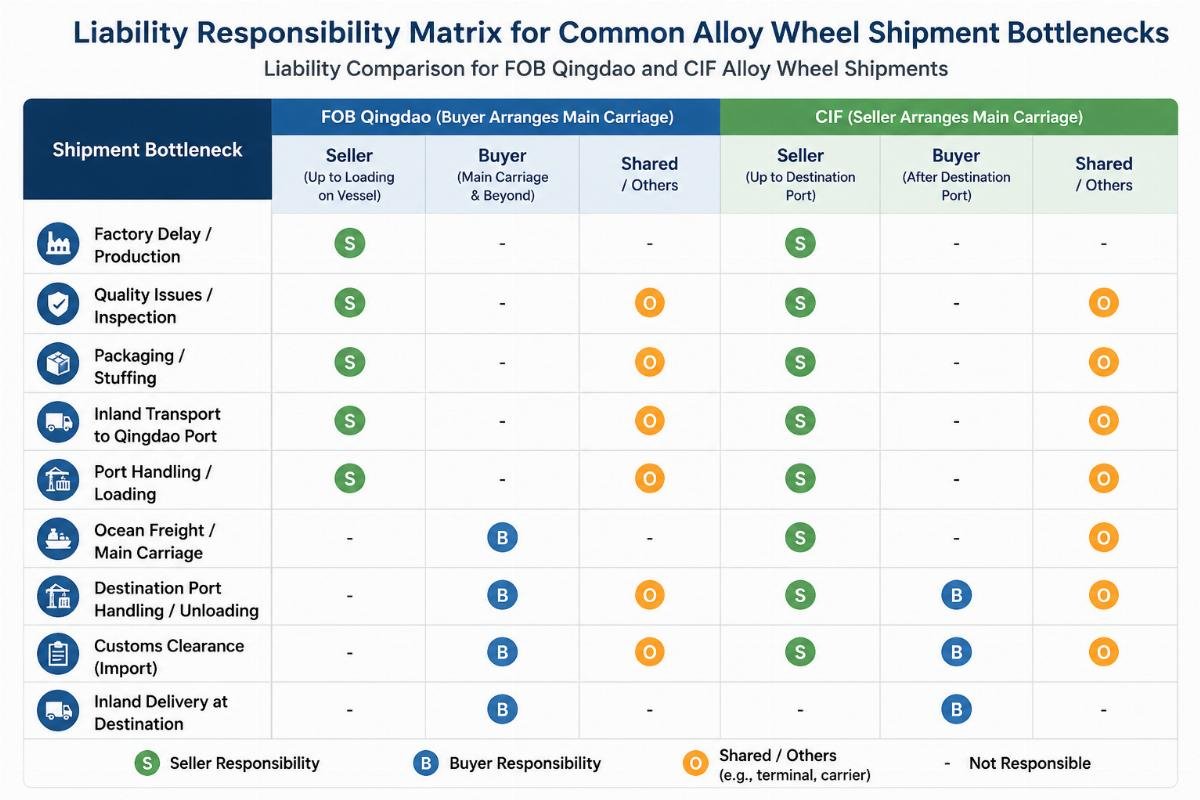
What liability risks come with FOB vs CIF for fragile alloy wheel shipments?
FOB shifts full quality verification responsibility to the buyer before goods leave the Chinese port, while standard CIF terms include basic carrier insurance for in-transit damage to fragile alloy wheels. The biggest risk gap almost always occurs when buyers skip pre-shipment checks under FOB terms, leading to rejected stock that has no coverage once it leaves the factory.
| Shipment Risk Point | FOB Qingdao Liability | CIF Liability |
|---|---|---|
| Port congestion delays | Buyer | Supplier |
| Customs hold at origin | Buyer | Supplier |
| In-transit damage | Buyer | Supplier (up to declared value) |
| Post-production quality defects | Buyer | Buyer |
A Southeast Asian OEM auto plant securing a 30,000-piece annual supply agreement recently evaluated both terms for their recurring monthly container shipments, and found that FOB Qingdao let them build a fixed pre-shipment inspection step into their regular workflow, eliminating 98% of quality-related rejections that had occurred under their prior CIF structure. The consistent inspection check added only 2 days to their total lead time, but cut their total defect-related losses by more than $40,000 per year.
- Inspection Clause Definition – Explicitly outline pre-shipment inspection requirements in your contract regardless of which term you choose.
- Insurance Add-On – Add supplementary cargo insurance for high-value custom orders to cover gaps in standard CIF coverage.
- Bottleneck Contingency – Build 7 days of buffer time for origin port congestion when selecting either term for time-sensitive stock.
Conclusion
The optimal trade term for your alloy wheel order is never a universal default, and aligning it to your specific order parameters will deliver far more value than sticking to a single option for every purchase. The common assumptions that CIF is always lower risk or that trade terms only impact freight costs lead to thousands of dollars in avoidable losses for buyers every year. Taking the extra step to evaluate your order volume, buyer type, and risk exposure before agreeing to terms will eliminate hidden fees, reduce lead times, and cut down on avoidable shipment disputes. This approach works for every order size, from small 20-piece test batches to 30,000-piece annual OEM supply contracts.

