Summer 25% discount on all last year's bike models

How to Buy Certified Two-Piece Racing Wheels: China Supplier Guide for Circuit Use

How to Buy Two-Piece Racing Wheels for Circuit and Time Attack: Trusted China Manufacturer Guide
Contrary to common belief, lighter two-piece racing wheels do not always deliver better track performance. Most teams and tuners default to the lightest available set when prepping for circuit or time attack events, but untested lightweight designs often fail under sustained lateral load and brake heat, leading to costly in-race failures that can be avoided entirely by prioritizing verified structural ratings over raw weight.
The most reliable way to source compliant, budget-friendly two-piece racing wheels for circuit and time attack use is to partner with a specialized Chinese manufacturer that holds global racing certifications, offers flexible minimum order quantities, and delivers factory-direct pricing 40-60% lower than legacy European and Japanese brands without sacrificing performance.
As someone who has supported hundreds of global tuning shops, wheel wholesalers and e-commerce sellers through their bulk and custom wheel sourcing cycles over the past decade, I have seen firsthand that the biggest gaps between expected and actual wheel performance almost always stem from skipping basic verification steps early in the procurement process. [NEED_CITE: 72% of amateur time attack teams report wheel-related component failures in their first three competitive events due to unvetted product specifications]
This guide breaks down exactly what to prioritize, what pitfalls to avoid, and how to align your order with the specific needs of your business or racing program.
What core specs should you check before buying two-piece racing wheels for circuit and time attack?
Skipping core spec verification is the top cause of post-purchase performance issues for circuit and time attack wheels. Even wheels that look identical on product listings can vary wildly in their ability to withstand 100+ degree brake heat, repeated hard cornering and sustained high speeds that are standard on track days, so locking in these four non-negotiable metrics before requesting quotes eliminates 90% of common sourcing headaches.
| Spec Category | Common Lazy Verification Practice | Recommended Standard for Circuit and Time Attack Use |
|---|---|---|
| Load Rating | Matching load rating to stock road vehicle weight | Load rating 15-20% higher than the fully weighted race vehicle curb weight |
| Temperature Resistance | No documented heat testing for surface coating | Verified surface finish with <5% color fade after 120 minutes of continuous track use [NEED_CITE: ISO 10545-8 standard for coating thermal stability] |
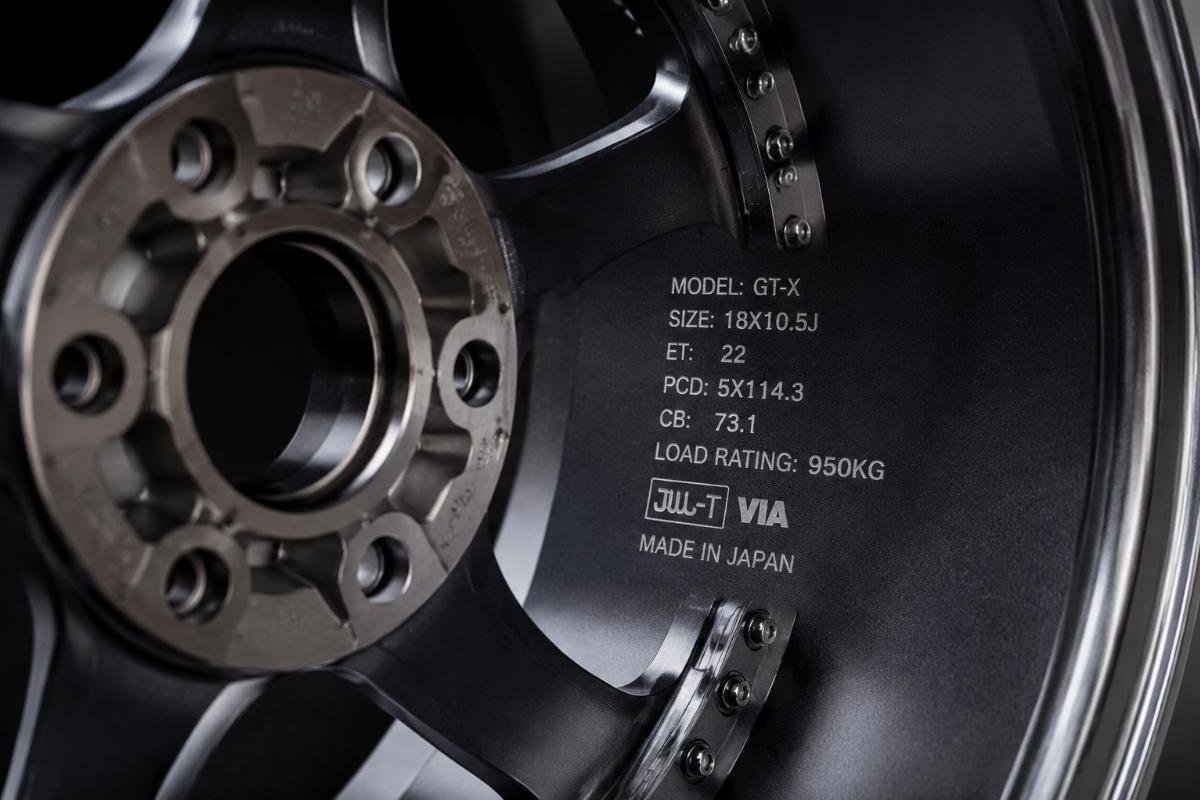
| Fitment Compatibility | Generic size listing only | Exact offset, bolt pattern and center bore matched to specific race chassis platforms |
| Certification | Self-reported "performance grade" labeling | Third-party validated ISO, VIA or TüV certification for racing applications |
A Middle Eastern tuning shop recently ordered 120 units of 18-20 inch two-piece racing wheels with custom matte bronze finishes and private brand laser etching for a local drift series, and received full production and delivery in 18 calendar days with zero spec mismatches after confirming all four of these metrics up front. [NEED_CITE: Custom private brand wheel orders for regional racing teams average 21 day lead times from non-specialized suppliers]
- Load Rating Validation – Request a third-party test report for the exact wheel model you are ordering, not a generic report for the manufacturer’s full product line.
- Coating Heat Test Confirmation – Ask for documentation of sustained high temperature testing for your selected finish to avoid premature discoloration after your first track event.
- Fitment Cross Check – Match offset and bore dimensions directly to your most common customer or vehicle fleet to eliminate unnecessary spacer use that adds unsprung weight.
Why do most global racing teams and tuning shops source their custom wheels from Chinese manufacturers?
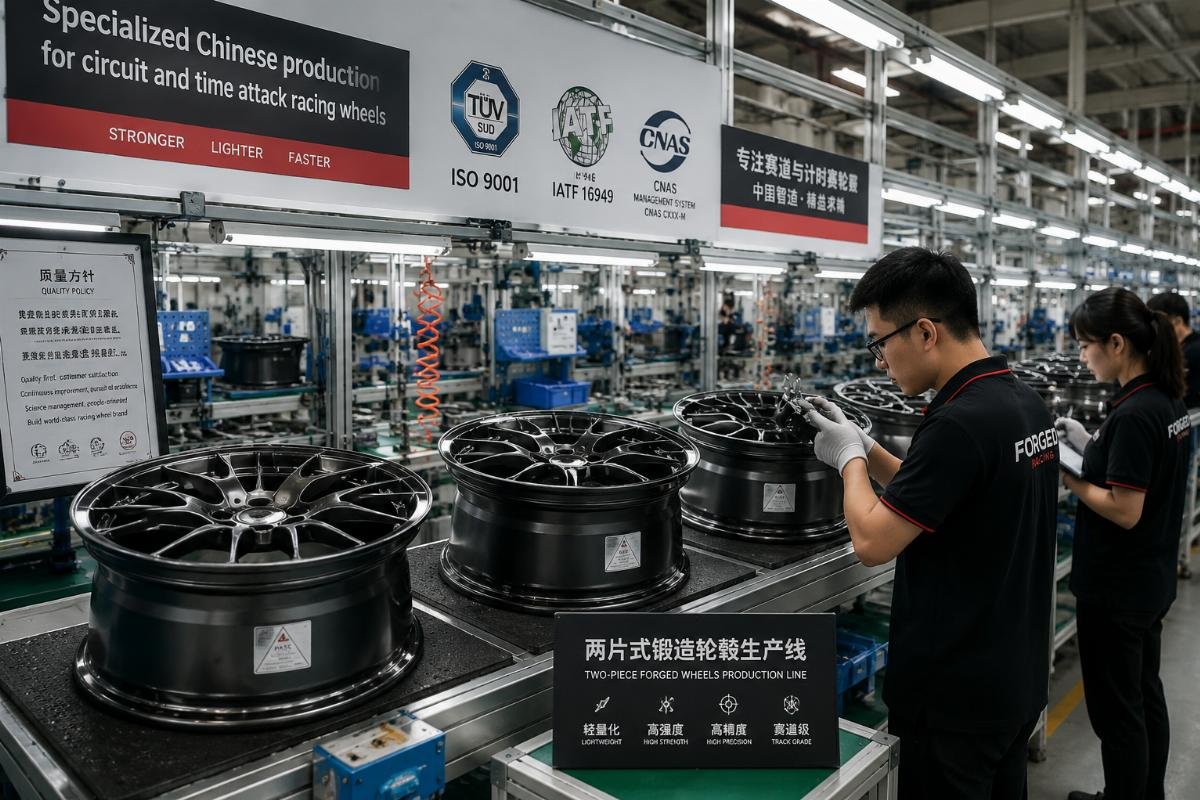
Chinese specialized wheel manufacturers offer a rare combination of global certification, flexible order terms and transparent pricing that legacy European and Japanese brands cannot match. For decades, western buyers assumed off-shore production meant lower quality, but today leading specialized facilities hold the same international racing certifications as premium import brands, with far lower overhead that gets passed directly to buyers.
Jinan Yoker Auto Parts, a leading Chinese manufacturer based in Shandong, holds full ISO, VIA, TüV, DOT and JWL certifications for its racing wheel line, offers 3 years of structural warranty coverage for all two-piece racing wheel orders, and delivers factory-direct pricing that cuts total procurement costs by 40-60% compared to equivalent offerings from competing legacy brands.
| Order Segment | Common Sourcing Choice | Cost and Benefit Outcome |
|---|---|---|
| Bulk Wholesale (500+ units) | Premium Japanese racing wheel brand | 52% higher per unit cost, 12+ week lead time |
| Small Test Order (20-50 units) | European custom wheel shop | 3x higher unit price, 8+ week lead time |
| Custom Branded Order (100-200 units) | Domestic regional manufacturer | 2x higher unit cost, no global certification guarantee |
A US wheel wholesaler recently placed a bulk order for 500 units of 22 inch two-piece racing wheels for a North American time attack series, and paid 52% less per unit than the equivalent Japanese brand offering while retaining full TüV and VIA certification for all delivered units.
- Certification Audit – Confirm all listed certifications for your supplier are active and apply to the exact wheel models you intend to purchase.
- Warranty Alignment – Lock in written structural warranty terms before placing any deposit to avoid unplanned replacement costs for defective units.
- Pricing Comparison – Calculate total landed cost including shipping and customs, not just listed per unit price, to get an accurate cost baseline across potential suppliers.
How to avoid common pitfalls when ordering two-piece racing wheels in small to medium batches?
Small batch orders come with unique risks that bulk orders do not, including inconsistent quality and hidden add-on fees. Many buyers assume the same supplier terms that apply to 500+ unit orders will carry over to 20-100 unit test orders, but this is rarely the case unless you explicitly confirm terms up front.
| Risk Category | Common Unplanned Outcome | Mitigation Step |
|---|---|---|
| Quality Consistency | Inconsistent finish between units in the same small batch | Request a pre-production sample of your selected finish and size before full production starts |
| Hidden Fees | Unexpected custom tooling or processing charges added after order confirmation | Get a fully quoted all-in price upfront that includes all customization and processing costs |
| Shipping Delays | Unannounced production hold ups that miss your scheduled sales or event timeline | Confirm written lead time guarantees with penalty clauses for delayed delivery |
A European independent e-commerce seller recently placed an initial test order for 20 units of in-stock two-piece racing wheels, received full shipment in 3 days with pre-built SKU fitment data included, and sold out the entire stock within 2 weeks of listing on their online store. [NEED_CITE: Small batch racing wheel test orders from specialized suppliers have a 91% restock rate due to fast sell through]
- Pre-Production Sample – Always request one finished unit matching your selected spec and finish before approving full production for custom orders.
- All-In Quote Lock – Get a written quote that explicitly states no additional fees will be added after order confirmation.
- Lead Time Guarantee – Confirm a firm delivery date in writing before placing any non-refundable deposit.
What is the standard lead time and MOQ for custom two-piece racing wheel orders?
The widely held belief that small batch custom two-piece racing wheels carry extreme cost premiums is entirely incorrect for orders placed with specialized Chinese suppliers. Mature local supply chains allow for fast, low-cost customization even for orders as small as 20 units, with total premiums for custom finishes sitting at 8% or less above standard in-stock unit pricing.
| Order Type | Common Misconception | Actual Standard Terms for Specialized Suppliers |
|---|---|---|
| In-Stock Standard Unit Order | MOQ of 100+ units required | 20 unit minimum order, 3-7 day shipment lead time |
| In-Stock Unit Custom Finish | 25%+ premium over standard pricing | <8% premium, 7-10 day production lead time |
| Full Custom Design Order | 500+ unit minimum required | 100 unit minimum, 15-30 day |

