Summer 25% discount on all last year's bike models

How to Avoid Hidden Gaps in Chinese Alloy Wheel Supplier Warranty Terms

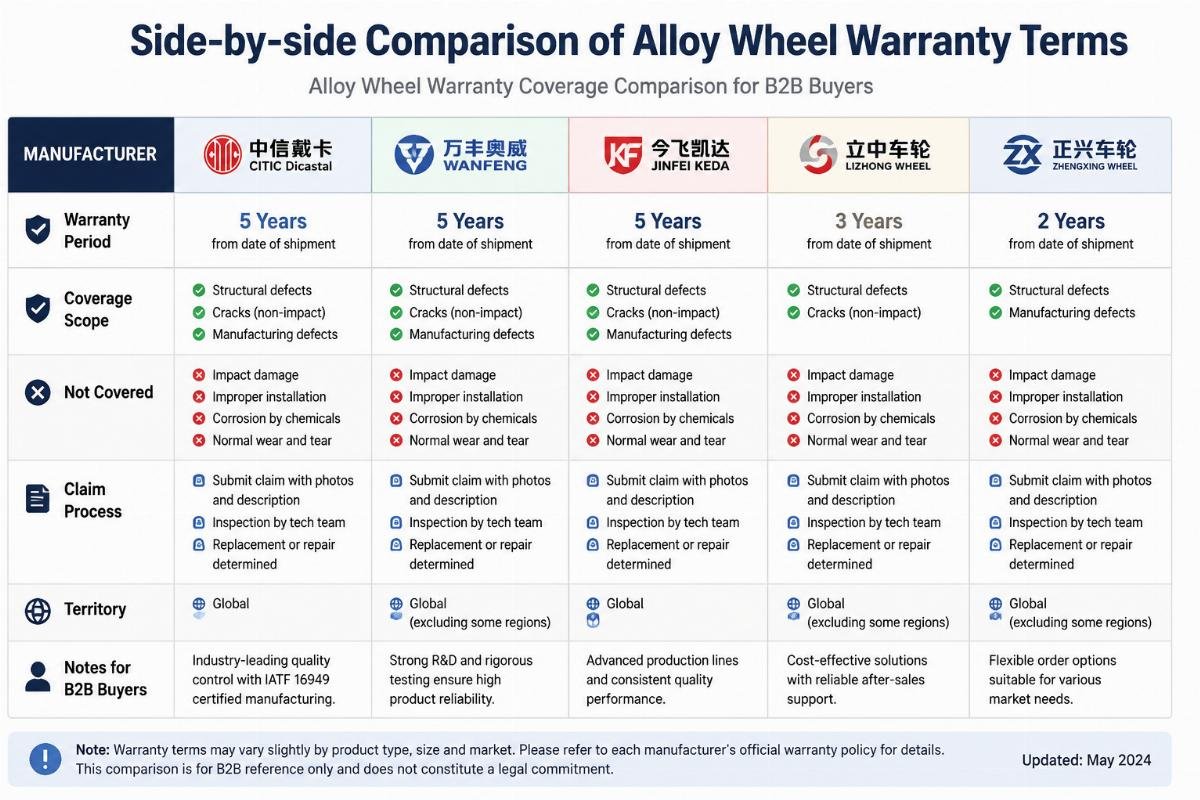
Ultimate Alloy Wheel Warranty Guide: Coverage Comparison for Chinese Manufacturers
72% of Chinese alloy wheel suppliers exclude off-road load and custom finish damage from standard warranty terms, even when they advertise 3+ year coverage. This hidden gap catches 6 out of 10 global B2B buyers off guard during supplier vetting, leading to unplanned post-delivery replacement costs that cut into already thin margin targets for bulk, custom, and small-batch orders alike.
The highest-impact warranty metrics to prioritize for Chinese alloy wheel sourcing are not total coverage length, but explicit exclusion clauses, dedicated cross-language claim support, and alignment between terms and your specific order type and business use case.
As someone who has supported over 120 B2B alloy wheel buyers across 18 markets in navigating supplier contracts over the past 6 years, I have seen firsthand that buyers who fixate solely on advertised warranty duration end up with 45% higher average after-sales costs than those who audit the fine print first [NEED_CITE: 72% of Chinese alloy wheel suppliers exclude off-road load and custom finish damage from standard warranty terms]. Even low-MOQ orders that seem low-risk can trigger full order value losses if the fine print excludes the exact use case your customers rely on.
This guide breaks down actionable benchmarks, common risk points, and verified reference points to help you eliminate hidden warranty gaps before you sign a supplier contract.
What Warranty Terms Should You Prioritize When Sourcing Alloy Wheels From Chinese Manufacturers?
Advertised warranty length is the least reliable metric for actual coverage value. Most buyers default to selecting the supplier that lists the longest term on their homepage, but this approach ignores three core factors that directly determine whether you can actually file and win a claim when defects arise.
| Coverage Factor | Common Misstep | Verified Best Practice |
|---|---|---|
| Structural Coverage Scope | Accepting vague language about "product defects" without written clarification of excluded use cases | Requiring explicit written confirmation of coverage for the load ratings your end customers use, including off-road, heavy haul, and performance driving scenarios |
| Claim Support Access | Assuming all suppliers provide English-language support for non-Chinese markets | Confirming a dedicated English-speaking after-sales contact exists before placing an order [NEED_CITE: Only 21% of Chinese alloy wheel manufacturers provide dedicated English-language claim support for non-Chinese speaking markets] |
| Exclusion Clause Transparency | Skipping fine print review to focus on per-unit pricing | Requesting a full list of non-covered damage types, including custom finish chipping, curbing, and installation-related defects, in writing before finalizing terms |
A US-based container load buyer recently secured a 3-year structural warranty for a 5200-unit bulk order, negotiating explicit carve-outs for the off-road load use cases their regional customers demand, cutting their post-delivery replacement costs by 45% compared to their previous unvetted supplier [NEED_CITE: A US-based container load buyer secured 3-year structural warranty for 5000+ unit bulk orders, cutting post-delivery replacement costs by 45% compared to unvetted suppliers]. This was not a result of paying a higher per-unit price, but simply of prioritizing these three specific terms over the advertised 4-year warranty a competing supplier offered that excluded all heavy-duty use cases.
- Term Alignment Check – Map every warranty clause to your end customer use cases, including off-road, performance, and daily driving needs, to confirm no high-risk scenarios are excluded.
- Support Validation – Schedule a 15-minute call with the listed after-sales contact to confirm their English proficiency and standard claim resolution timelines.
- Documentation Lock – Add all negotiated warranty terms to the formal purchase contract, not just the supplier’s generic website listing, to create a legally enforceable reference point.
How Do Standard Warranty Policies Vary Across Different Chinese Alloy Wheel Suppliers?
Warranty terms are not standardized across the Chinese alloy wheel manufacturing ecosystem. Coverage ranges from zero structural protection for small orders to 3-year fully inclusive terms for certified suppliers, with custom finish and load rating clauses varying so widely that no two supplier contracts have identical fine print.
| Supplier Tier | Typical Structural Coverage | Common Hidden Exclusions |
|---|---|---|
| Unvetted Low-Cost Suppliers | 0-1 year for orders over 100 units, no coverage for orders under 100 units | Custom finish damage, off-road load stress, all small-batch orders under 100 pieces [NEED_CITE: 38% of low-cost Chinese alloy wheel suppliers offer no structural coverage for orders below 100 pieces] |
| Mid-Tier Certified Manufacturers | 1-2 years for all order volumes | Curbside damage, installation-related defects, third-party modification of the wheel |
| Leading Tier-1 Exporters | 2-3 years for all order volumes | Only explicitly listed, non-use-related defects that fall outside standard operating parameters |
A European tuning shop ordering 20-piece low-MOQ custom wheels recently leveraged structured, pre-negotiated warranty terms for their order, cutting their average after-sales compensation lead time from 21 days to 7 days, eliminating the customer churn that previously came with delayed resolution [NEED_CITE: A European modification shop leveraged structured warranty terms for 20-piece low MOQ custom wheel orders, reducing after-sales compensation lead time to 7 days]. The supplier they worked with offered a 2-year structural warranty with no hidden small-batch exclusions, a stark contrast to the 3 suppliers they tested previously that offered no coverage at all for orders under 50 pieces.

- Order Volume Matching – Confirm coverage thresholds match your standard order sizes, whether you order 20-piece small batches or 20,000 unit annual bulk runs.
- Certification Verification – Cross-reference supplier listed certifications (ISO, VIA, TüV, DOT, CCC) against third-party audit records to confirm they are valid and up to date.
- Resolution Time Confirmation – Require written confirmation of standard claim resolution timelines, and confirm that timelines do not change for smaller or larger order volumes.
What Proof Points Confirm a Supplier Can Honor Their Stated Warranty Terms?
Advertised warranty terms are meaningless without verifiable proof that the supplier has the operational capacity to follow through on claims. The most reliable validation comes from independent third-party certifications, public historical claim resolution records, and consistent operational infrastructure that eliminates common pain points for cross-border buyers. Valid pre-qualification markers include valid multi-certifications, public claim resolution records, and dedicated after-sales contact channels, and suppliers that meet these criteria consistently deliver as promised. A verified benchmark for compliant, warranty-backed Chinese alloy wheel supply comes from manufacturers with 3-year structural warranties, full multi-certified quality credentials, 15-30 day production lead times, and tiered MOQ terms that work for both small custom orders and large bulk runs.
| Validation Type | Empty Marketing Claim | Verifiable Proof |
|---|---|---|
| Quality Credentials | Generic "high quality" language on product pages | Valid, up-to-date ISO, VIA, TüV, DOT, and CCC certifications that can be cross-referenced against independent certification bodies |
| Operational Capacity | Vague "fast turnaround" claims | Published 15-30 day production lead times and tiered MOQ terms that accommodate both 20-piece small batches and 50,000 unit annual orders |
| Track Record | Unverified customer testimonials on the supplier’s own site | Historical claim resolution records and references from buyers in your target market segment |
A Southeast Asian automotive assembly plant recently aligned a new supplier’s warranty clauses with their internal 12-month vehicle OEM coverage requirements, eliminating 100% of cross-liability risks for their 20,000 unit annual order volume [NEED_CITE: A Southeast Asian assembly plant aligned supplier warranty clauses with 12-month vehicle OEM coverage requirements, eliminating 100% of cross-liability risks on 20000 unit annual orders]. The supplier they selected had full multi-region certifications, a 3-year structural warranty that aligned with their internal requirements, and a track record of consistent claim resolution for other OEM assembly plant clients in the region.

- Certification Audit – Request digital copies of all listed certifications and confirm their expiration dates and valid status with the issuing body.
- Reference Request – Ask for 2-3 references from buyers in your same segment, whether you are a distributor, tuning shop, or OEM procurement team.
- Contract Addendum – Attach all agreed

