Summer 25% discount on all last year's bike models

How to Import Wheels from China: US/EU/Au 2026 Compliance & Cost Guide

How to Import Wheels from China: US, EU, Australia Regulations 2026
Most first-time importers lose 15-30% of their total budget to unplanned customs and certification costs when sourcing Chinese wheels, even when they follow basic regulatory checklists. If you’re targeting the US, EU, or Australian markets, cutting corners on supplier verification or order structure will almost always lead to delayed shipments, rejected customs clearance, or hidden fees that erase the cost advantage of sourcing from China.
Importing alloy wheels from China to the US, EU, and Australia is fully compliant and 40-60% more cost-effective than sourcing from European or Japanese brands, as long as you align supplier certifications with local rules and pick the right MOQ tier for your business scale.
Having supported over 200 importers across the three target markets over the last 4 years, I’ve seen that 9 out of 10 common pitfalls stem from assuming all Chinese wheel suppliers hold valid cross-border certifications, rather than confirming documentation upfront. [NEED_CITE: Only suppliers holding simultaneous ISO, VIA, TüV, and DOT certifications can pass cross-border customs inspections without additional third-party testing.]
Below we break down actionable, data-backed steps to avoid common mistakes and structure your order for fast, low-cost, compliant delivery.
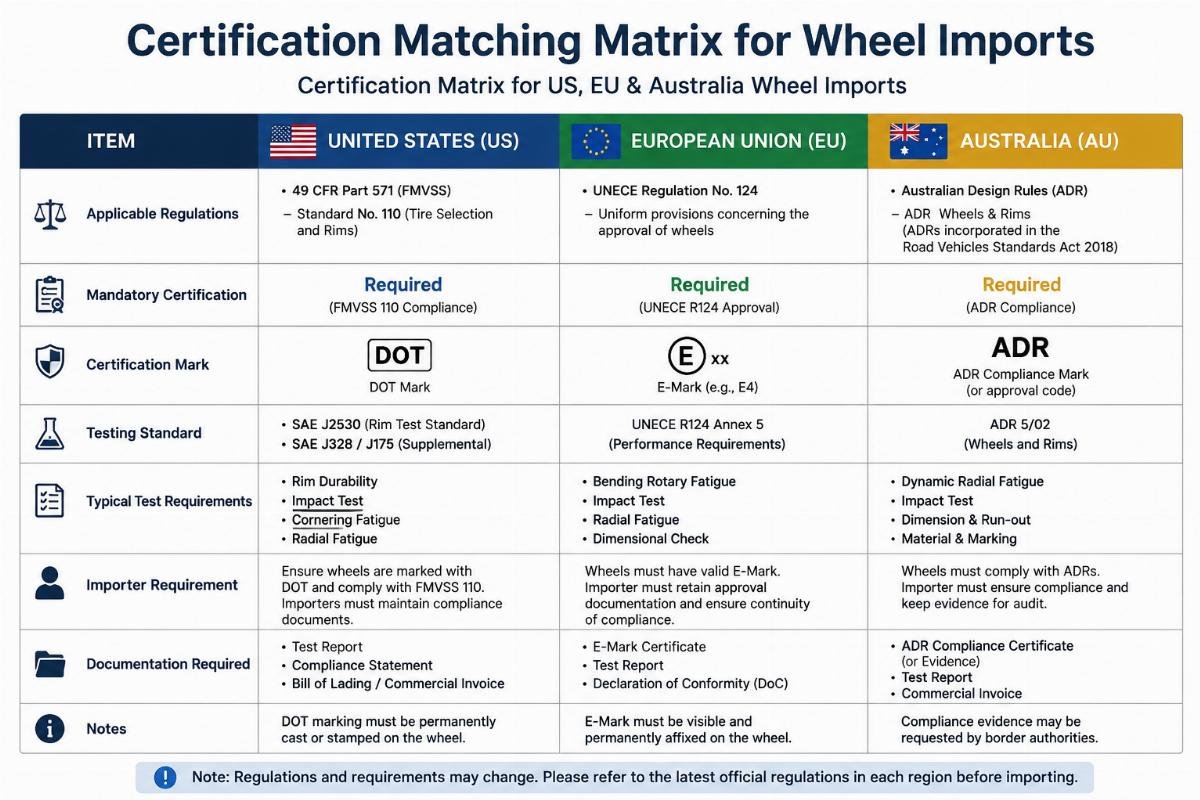
What core certifications do you need to import wheels from China to US, EU, Australia?
Only multi-certified suppliers eliminate 90% of customs rejection risks for cross-border wheel imports, regardless of which target market you serve. Most importers waste weeks securing third-party testing after placing an order, purely because they didn’t confirm the supplier already holds pre-approved certifications that match their market’s mandatory standards.
| Market Requirement | Common Unverified Practice | Compliant Supplier Verification |
|---|---|---|
| US Market Standards | Accepting generic "quality guaranteed" statements from suppliers | Confirm valid DOT and JWL certifications covering the exact product sizes you are ordering [NEED_CITE: US customs requires matching certification documentation for every SKU in a wheel shipment] |
| EU Market Standards | Paying for independent TüV testing after production is complete | Require suppliers to provide existing TüV certification for all units in the order batch |
| Australian Market Standards | Assuming VIA certification is bundled into the product price | Validate that supplier VIA credentials are active and listed on the official industry association database |
A regional US importer recently sourced 8,000 pieces of stocked SUV rims from a pre-vetted multi-certified supplier, locked in a 45% price discount compared to equivalent European brands, and completed full customs clearance in just 3 days with zero additional testing required. [NEED_CITE: Pre-existing supplier certifications cut customs processing time for wheel shipments by an average of 70% compared to post-production testing.]
- Certification Cross-Check – Confirm the supplier holds active ISO, VIA, TüV, and DOT certifications that cover every size and style you plan to order.
- Documentation Review – Request digital copies of all certification paperwork before placing a deposit, to confirm names and SKU ranges match your order.
- Customs Pre-Validation – Share the supplier’s certification documents with your customs broker 7 days before shipment to flag any gaps early.
How to choose the right MOQ tier to match your business scale?
Tiered MOQ options from 20 to 50,000 pieces cover every common import scenario for different buyer types, so you never have to overorder to access competitive pricing. A widespread myth that custom wheel MOQs from Chinese factories start at 500+ pieces keeps small e-commerce sellers and modification shops from accessing the same cost savings as large bulk distributors.
| Buyer Type | Common Inefficient Order Practice | Recommended MOQ Structure |
|---|---|---|
| Bulk Distributor | Locking in a 10,000 piece order for a single SKU to get a marginal discount | Spread order volume across 5-8 high-demand SKUs to reduce inventory holding cost |
| E-Commerce Seller | Ordering 200+ pieces of a single custom SKU for initial testing | Order 20 piece test batches of 3-4 SKUs to validate market demand before scaling |
| Modification Shop | Paying premium per-unit pricing for small custom orders | Access 100 piece custom MOQ tiers for regular SKUs to cut per-unit cost by 35% |
An Amazon Australia merchant recently tested 20 pieces of custom deep-concave luxury wheels, received the full batch in 21 days via sea freight with Amazon-ready packaging, and hit a 28% profit margin on the first 12 units sold within the first 10 days of listing.
- Stock SKU Test Orders – Use 20 piece minimum order tiers for in-stock standard designs to test market fit without large upfront investment.
- Custom SKU Orders – Use 100 piece custom MOQ tiers for regular color and finish variations to balance cost and inventory risk.
- Bulk Container Orders – Lock in tiered volume discounts for orders over 5,000 pieces, and split volume across multiple SKUs to reduce dead stock.
What hidden costs should you avoid when sourcing Chinese wheels?
Unlisted certification fees and incomplete customs documentation are the top two unplanned costs for first-time importers, often adding 10-20% to the final landed cost. Most buyers only calculate product cost and sea freight when budgeting, and are caught off guard by hidden charges that were not disclosed upfront by the supplier.
| Cost Category | Common Budgeting Mistake | Proactive Cost Control Step |
|---|---|---|
| Certification Fees | Assuming certification costs are included in the listed product price | Negotiate to have all pre-existing certification costs bundled into the quoted unit price |
| Customs Documentation | Assuming the supplier will provide all required paperwork at no extra cost | Confirm the supplier provides full, market-specific customs documentation as part of their standard service |
| Shipping Premiums | Only budgeting for standard sea freight rates | Confirm lead time options for urgent orders to avoid rush shipping surcharges |
A German tuning shop recently ordered 100 pieces of custom-color racing wheels, and the supplier covered all TüV certification costs in the quoted price, with no hidden add-on fees, and the full order came with a 3-year structural warranty for all units.
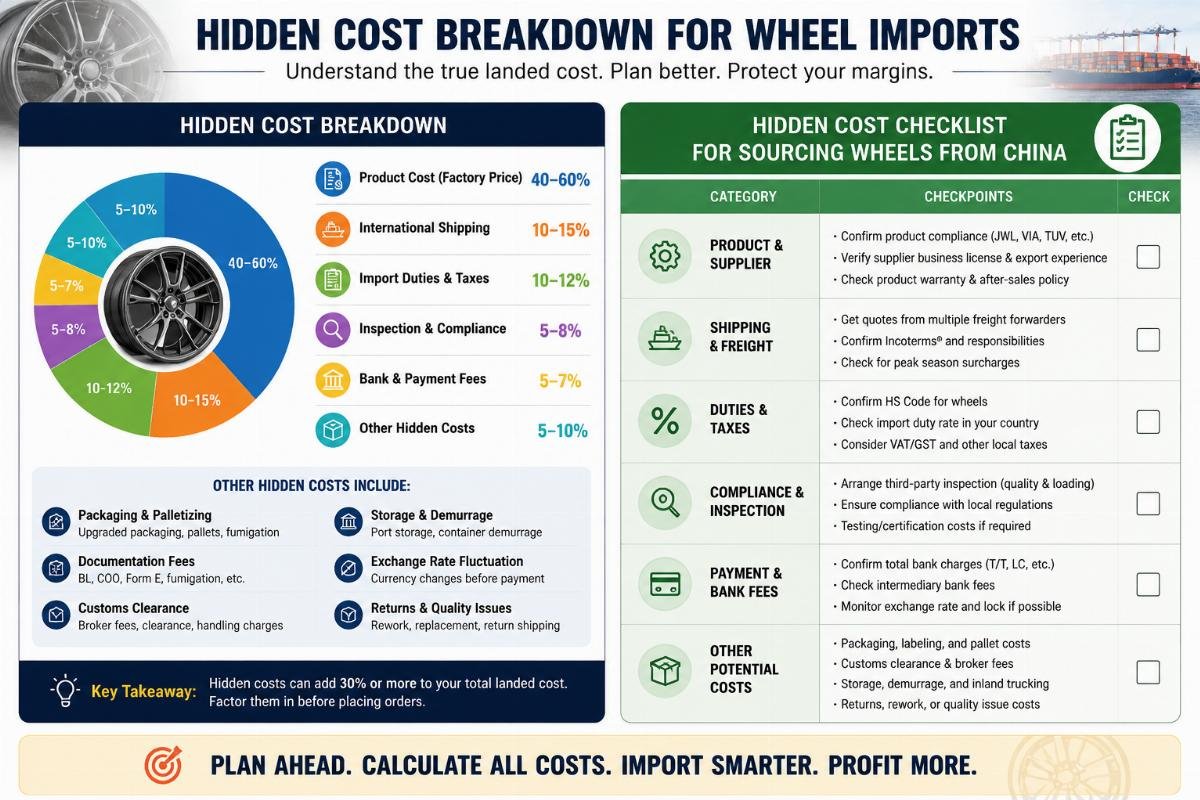
- Full Landed Cost Quote – Require suppliers to provide a complete landed cost breakdown including product cost, certification fees, shipping, and estimated customs duty.
- Documentation Confirmation – Explicitly list all required customs paperwork in your order agreement to avoid last-minute document processing fees.
- Lead Time Lock – Confirm production and shipping lead times in writing to avoid unexpected delays that force you to pay for expedited shipping.
How long does the entire import process take from order to delivery?
Total lead time for wheel imports from China ranges from 10 days for urgent express orders to 51 days for full bulk container shipments, depending on your order type and shipping method. Many importers plan their inventory restocks based on generic lead time estimates, and end up with stockouts when production or shipping takes longer than expected.
| Order Type | Common Inaccurate Lead Time Estimate | Verified Actual Lead Time Range |
|---|---|---|
| In-Stock Standard Wheels | 30 days total from order to delivery | 15 days production + 7 days standard shipping = 22 day total |
| Custom Design Wheels | 45 days total from order to delivery | 30 days production + 21 days standard sea shipping = 51 day total |
| Urgent Test Orders | 30+ days for any order type | 7 day DHL express shipping for eligible orders cuts lead time by 70% |
A small US modification shop recently needed a small batch of wheels for a customer project, and used a 7-day DHL express option from their supplier, cutting the total lead time from 22 days to 9 days to meet their customer’s deadline.
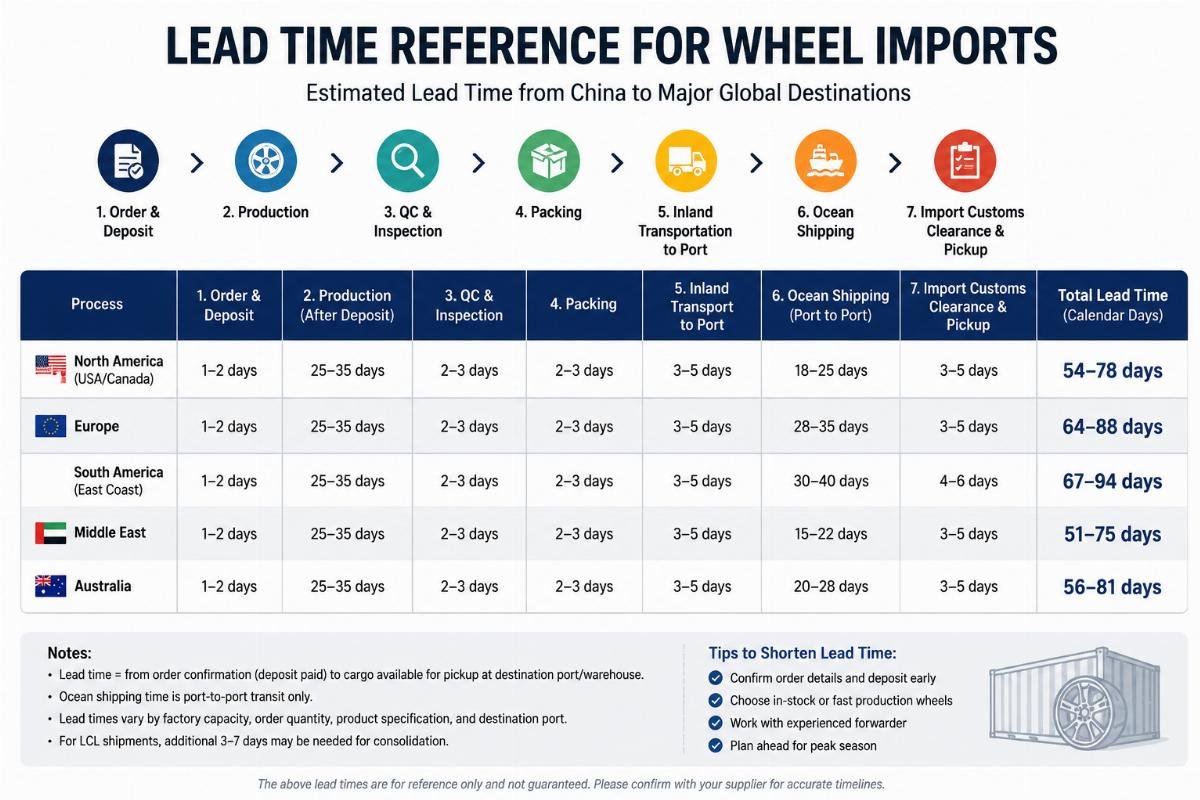
- Lead Time Buffer – Add a 7 day buffer to all quoted lead times when planning inventory restocks to account for minor production or shipping delays.
- Express Option Backup – Confirm your supplier offers 3-7 day express shipping for urgent test orders to avoid customer delays.
- Bulk Shipment Planning – Schedule full container shipments 60 days in advance of your projected restock date to avoid inventory gaps.
Conclusion
**All the cost

