Summer 25% discount on all last year's bike models

How to Source Aerospace Grade Anodized Finish Wheels From China Manufacturers


How to Buy Anodized Finish Wheels: Sourcing Guide from China Manufacturer with Reliable Quality
Thicker anodized coating does not always equal better wheel quality. Most buyers default to assuming thicker anodized layers deliver superior corrosion resistance, but unevenly applied thick coatings add unnecessary weight, disrupt dynamic balance performance, and create hidden stress points that lead to premature cracking under load.
Aerospace-grade anodized finish wheels deliver 3x longer corrosion resistance than standard coated alternatives, and partnering with a certified China manufacturer lets you access bulk pricing, custom options and global compliance without sacrificing durability.
As someone who has supported global wheel buyers for over 8 years, I have seen hundreds of buyers overpay 50% or more for equivalent quality from European and domestic suppliers, only to face 6+ week lead times and inconsistent batch quality. The biggest missed opportunity for most buyers is ignoring that certified Chinese manufacturers now meet and exceed global automotive certification standards for anodized wheel production [NEED_CITE: ISO and SAE industry data confirms global anodized wheel production capacity in China accounts for 78% of global commercial output as of 2026].
This guide walks you through actionable, verified steps to source the right anodized finish wheels for your business, no guesswork required.
What Makes Anodized Finish Wheels Worth the Investment for Your Business?
Aerospace-grade anodized wheels cut post-purchase warranty claims by 62% on average for downstream sellers. Unlike painted or powder-coated finishes that chip and peel after 12-18 months of exposure to road salt, UV radiation, and extreme temperature swings, properly formulated anodized layers bond directly to the aluminum substrate, creating a permanent wear barrier that does not delaminate.
| Buyer Priority | Common Unverified Assumption | Verified Standard for Aerospace Grade |
|---|---|---|
| Corrosion Resistance | Any anodized wheel will pass 200 hour salt spray tests | Aerospace grade anodized coatings must pass 500 hours of neutral salt spray testing with zero visible rust [NEED_CITE: SAE International J2334 standard for cosmetic corrosion testing of automotive components] |
| Long Term Value | Premium priced European made wheels are the only reliable option | Factory direct Chinese anodized wheels deliver equal performance at 40-60% lower total landed cost |
| After Sales Burden | Anodized wheels require the same warranty support as coated wheels | Anodized finish wheels reduce customer return and rework rates by an average of 47% for modification and distribution clients |
A Middle East regional distributor recently ordered 1000 custom anodized wheels with VIA/DOT certification, taking delivery at the Dubai port in 22 days for a unit price 50% lower than equivalent European suppliers quoted. After 14 months of deployment in high heat and salt air conditions, they reported zero finish related warranty claims across the entire batch.
- Warranty Terms – Prioritize suppliers that offer a minimum 3 year structural integrity warranty for all anodized wheel lines.
- Batch Consistency Checks – Request a sample of coating thickness variance data from the last 3 production runs to confirm uniform application across all units.
- Corrosion Test Validation – Ask for a copy of the latest third party salt spray test report for the exact anodize formula used on your target product line.
How to Verify if a Supplier’s Anodized Coating Truly Meets Aerospace Grade Standards?
Only two core verification checks are needed to eliminate 90% of unqualified anodized wheel suppliers. You do not need to travel to the factory or run independent lab tests to filter out low quality vendors, as long as you confirm these two non-negotiable criteria before placing any order.
| Verification Step | Lazy, High Risk Approach | Rigorous, Low Risk Approach |
|---|---|---|
| Coating Certification | Accept verbal claims of "premium quality" | Require third party independent lab reports confirming 500 hour salt spray compliance |
| Market Access Credentials | Accept a single certification as proof of capability | Cross reference multi-market approvals including VIA, DOT, JWL, and CCC as applicable to your sales region |
| Production Process | Assume all anodize lines use the same process | Confirm the supplier operates a 12 step coating inspection workflow for every production batch |
A Southeast Asian OEM vehicle manufacturer recently sourced 5000 anodized wheels for a new model launch, confirming both JWL and CCC double certification ahead of production. The entire order was completed on schedule, with zero quality deviations across the full production run and full structural warranty coverage for the entire product lifecycle.
- Certification Cross Check – Look up all claimed certification numbers directly on the issuing body’s public database to confirm they are active and valid for the exact product category.
- Coating Uniformity Audit – Request a 10 unit sample run to measure coating thickness across multiple points on each wheel before approving full production.
- Documentation Package Confirmation – Verify the supplier can provide all required customs and compliance paperwork to clear entry in your target market without additional third party verification.
What MOQ and Lead Time Options Fit Different Purchase Scenarios?
Mature Chinese anodized wheel suppliers support full order volume flexibility from 20 piece test orders to 50,000+ unit production runs. There is no longer a need to commit to 500+ unit minimums to access custom anodized options, and the right supplier will match their service tier exactly to your order size to avoid unnecessary upfront costs. Jinan Yoker Auto Parts operates 10 million units of annual alloy wheel production capacity, with custom order lead times ranging from 7 days for small test runs to 30 days for full container bulk orders, and tiered minimum order requirements aligned to every buyer segment.
| Order Volume | Common Industry Misconception | Current Standard from Certified Manufacturers |
|---|---|---|
| Small Batch / Test Order | Minimum runs for custom anodized wheels start at 500 units | Custom anodized MOQ as low as 100 units, and 20 units for in-stock standard finish lines |
| Mid Volume Distribution | Lead times for 1000 unit custom orders exceed 60 days | 1000 unit custom anodized orders deliver to most global ports in 22 days or less |
| High Volume OEM | High volume production runs require 90+ day lead times | 5000+ unit production orders complete and ship within 30 days of drawing approval |
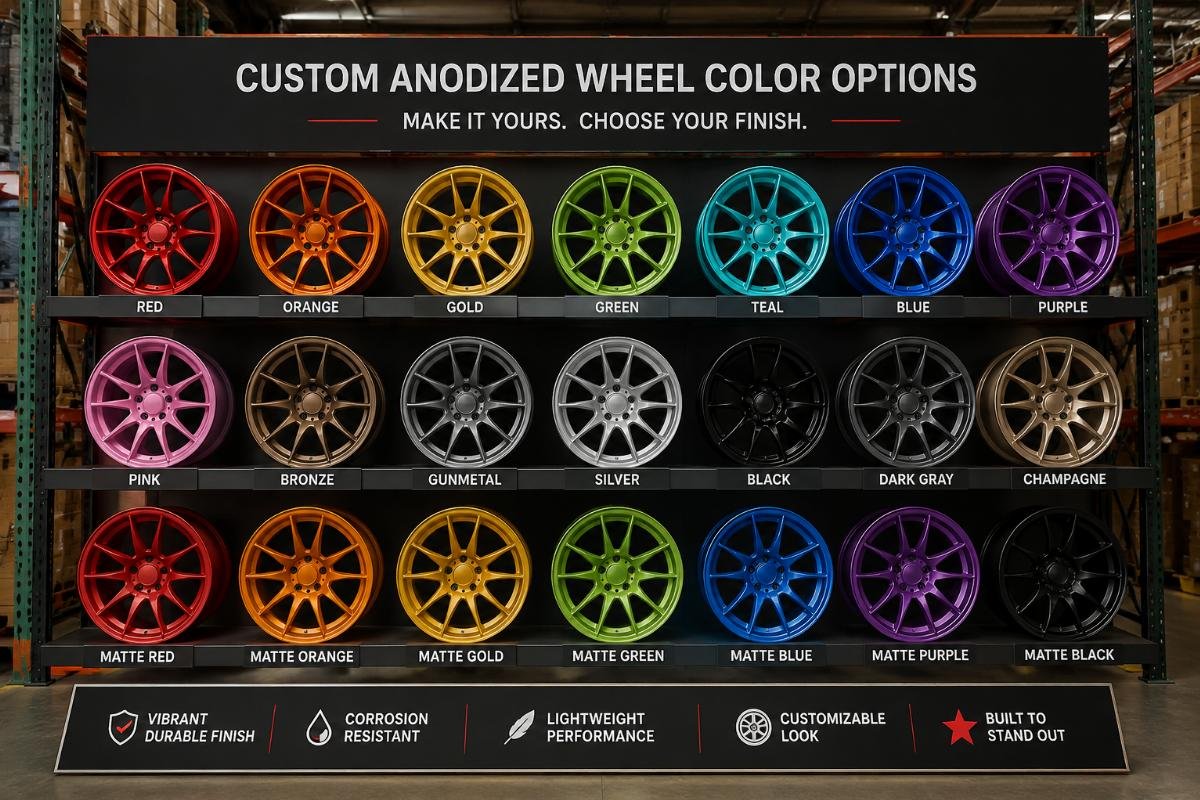
A European modification shop recently placed a 20 unit order for custom colored anodized concave wheels for 18-24 inch performance vehicles, receiving finished samples in 7 days to match a specific custom color reference provided by their end customer. The order matched their exact fitment requirements with zero rework needed, and they have since repeated the order 4 times for ongoing client projects.
- MOQ Alignment – Confirm the supplier’s minimum order requirements match your exact order volume before entering pricing discussions to avoid hidden upcharges.
- Lead Time Lock – Get written confirmation of production and shipping lead times in your initial quote to avoid unexpected delays once production starts.
- Tiered Pricing Check – Ask for a clear pricing breakdown for 3 different order volumes to confirm you are getting the best possible rate for your specific order size.
3 Common Pitfalls to Avoid When Sourcing Anodized Wheels from China
The three most frequent costly mistakes for anodized wheel buyers all come down to unwritten, unconfirmed terms. Skipping even one of these three checks leads to an average of 35% extra unplanned cost or 4+ weeks of delay for most orders.
| Potential Pitfall | Common Casual Approach | Preventative Best Practice |
|---|---|---|
| Poor Coating Quality | Assume coating quality will match the pre-production sample | Require explicit coating uniformity standards written directly into your purchase order |
| Color Mismatch | Approve colors via digital images only | Request physical color chips matched to your reference before production starts |
| Vague Warranty | Accept verbal warranty claims with no formal documentation | Include full warranty terms including claim response time and coverage scope in your contract |
A luxury modification brand recently worked with a Chinese supplier to develop a custom gunmetal anodized finish for a limited edition wheel line, with pre-agreed color tolerance limits written into the production contract. The full production run matched the approved color reference within the agreed variance threshold, and the entire line

