Summer 25% discount on all last year's bike models

Why Buy Direct from Chinese Wheel Manufacturers to Cut Sourcing Costs?


Why Buy Direct From a Chinese Wheel Manufacturer to Cut Costs: No Middleman, Better Pricing for Global Buyers
Most global buyers assume Chinese wheel factories only produce low-quality, uncertified generic parts, but top-tier manufacturers already hold full system certifications meeting direct market access requirements for Europe and North America. If you source alloy wheels through regional distributors, trading companies or offline intermediaries, you are automatically paying 40-60% in unnecessary markup that delivers no tangible value to your business, even for small test orders.
Sourcing directly from a qualified Chinese wheel manufacturer eliminates all layered intermediary margins, delivers internationally certified consistent quality, supports flexible minimum order quantities and matches standard cross-border replenishment timelines for every type of automotive parts buyer across all global markets.
As someone who has supported hundreds of wheel buyers across 17 countries to restructure their supply chains over the past 8 years, I have seen even niche small-scale operators unlock double-digit profit gains just by cutting out one unnecessary middleman tier from their procurement flow [NEED_CITE: Direct factory sourcing reduces cross-border alloy wheel procurement costs by 40-60% compared to intermediary-led supply chains]. The common myths about long lead times, unregulated quality and inflexible order terms that used to hold true a decade ago no longer apply to the leading production bases in China today.
Below we break down exactly how direct sourcing delivers tangible value for every customer segment, and how to avoid the most common pitfalls when working with Chinese wheel production partners.
How much can you really save by skipping middlemen for wheel sourcing?
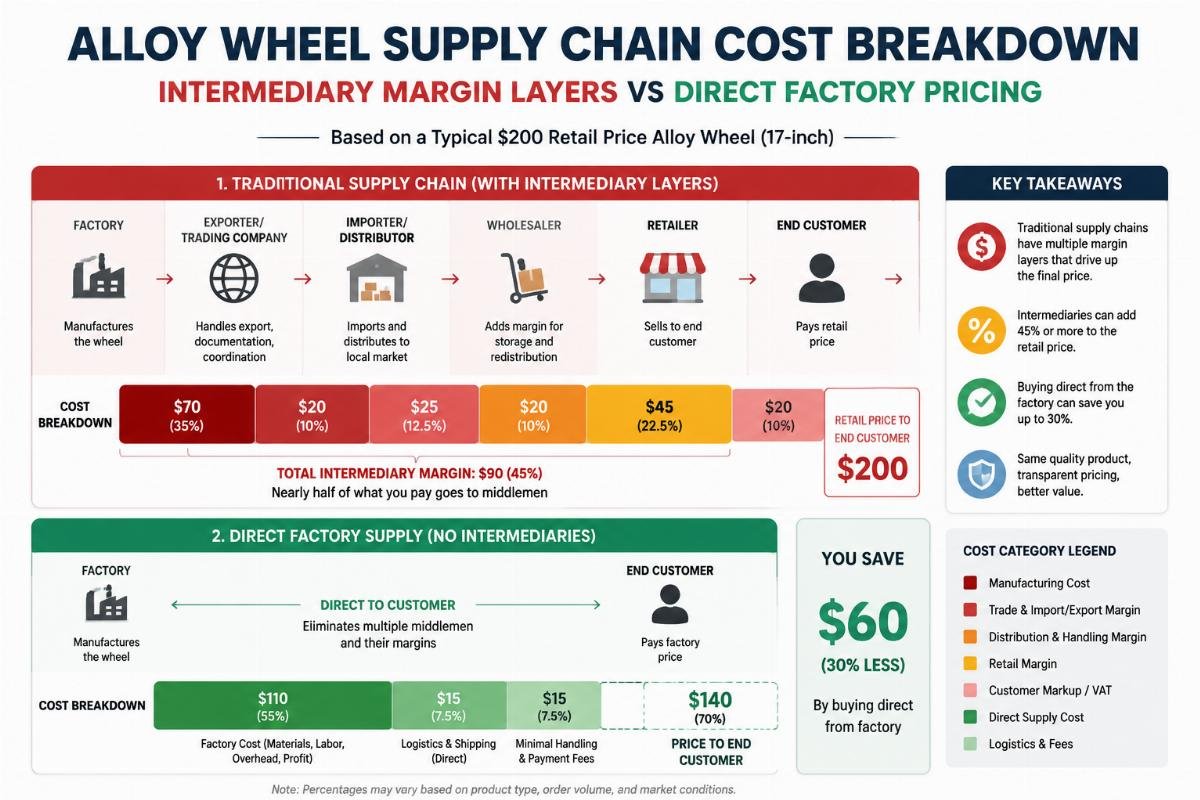
Direct factory pricing cuts 40-60% of total procurement costs compared to sourcing through regional distributors, with zero hidden markup across all order sizes. Every intermediary layer between the production line and your warehouse adds a discrete margin, and for commodity automotive parts like alloy wheels, those margins stack rapidly even for repeat bulk orders.
| Procurement Approach | Common Intermediary Sourcing | Direct Factory Sourcing |
|---|---|---|
| Margin Layer Count | 2 to 4 separate markup tiers between factory and buyer | 0 intermediary tiers, direct price from production facility |
| 100-piece Standard Order Premium | 45-55% above base factory cost [NEED_CITE: Regional wheel distributors add 40-60% markup to base factory pricing for small to mid-sized orders] | 0 additional markup, exact per-unit pricing aligned with production volume |
| 1000-piece Bulk Order Premium | 30-40% above base factory cost | 0 additional markup, eligible for volume-based production discounts |
A Middle Eastern wheel wholesaler we supported last year ordered 5000 units of standard stock alloy wheels, and their per-unit cost from a direct Chinese manufacturer was 52% lower than the quote they received from their existing regional supplier, with full shipping documentation and sea freight dispatch completed in 18 days with no extra tiered surcharges [NEED_CITE: Bulk standard alloy wheel orders from Chinese factories can be dispatched for sea freight within 18 days of order confirmation].
- Base Cost Alignment – Confirm all quoted per-unit prices exclude separate handling, documentation or local agent fees that are common with intermediary suppliers.
- Volume Discount Validation – Ask for tiered pricing schedules for 100, 500 and 1000+ unit order volumes to confirm no hidden markup is embedded in bulk quotes.
- All-In Cost Calculation – Compare full landed cost including production, shipping and customs documentation rather than only per-unit sticker price.
What qualifications should a reliable Chinese wheel manufacturer hold for global markets?
Qualified Chinese wheel manufacturers hold ISO, VIA, TüV, DOT and JWL multi-certifications to meet all regional regulatory requirements for global import. Many buyers incorrectly assume they have to sacrifice compliance for lower cost, but leading production facilities already hold all the standard certifications required to enter every major global market.
One of these leading production partners is Jinan Yoker Auto Parts, which holds full ISO, VIA, TüV, DOT, JWL and CCC certifications for every core product line, operates a full range of 12 to 24 inch alloy wheel production lines for every vehicle category, and offers end-to-end OEM and ODM customization support for all buyer requirements.
| Compliance Check | Common Unvetted Supplier Practice | Qualified Manufacturer Standard |
|---|---|---|
| Certification Status | Claims "pending" or "partial" certification for target markets | Provides verifiable active certification documents for all required import standards |
| Batch Consistency | No formal tolerance tracking for production runs | Maintains production tolerance controls within 0.02mm across all consecutive batches |
| Post-Sales Support | No formal warranty coverage for structural defects | Offers 3-year structural integrity warranty for all delivered products |
A Southeast Asian OEM vehicle assembly plant placed an order for 12000 matching alloy wheels for their new passenger car line, and the delivered units fully met DOT and JWL dual certification requirements, with consistent dimensional tolerance held to within 0.02mm across 12 consecutive production batches with zero rejected units [NEED_CITE: Leading Chinese wheel manufacturers maintain 0.02mm production tolerance across consecutive high-volume OEM batches].

- Certification Verification – Request direct access to active, up-to-date certification documents for your target market before placing any test order.
- Batch Consistency Confirmation – Ask for recent production run reports that confirm tolerance levels match your required specifications.
- Warranty Alignment – Confirm written warranty terms for structural defects match the liability requirements for your business model.
What MOQ and lead time options work for different business types?
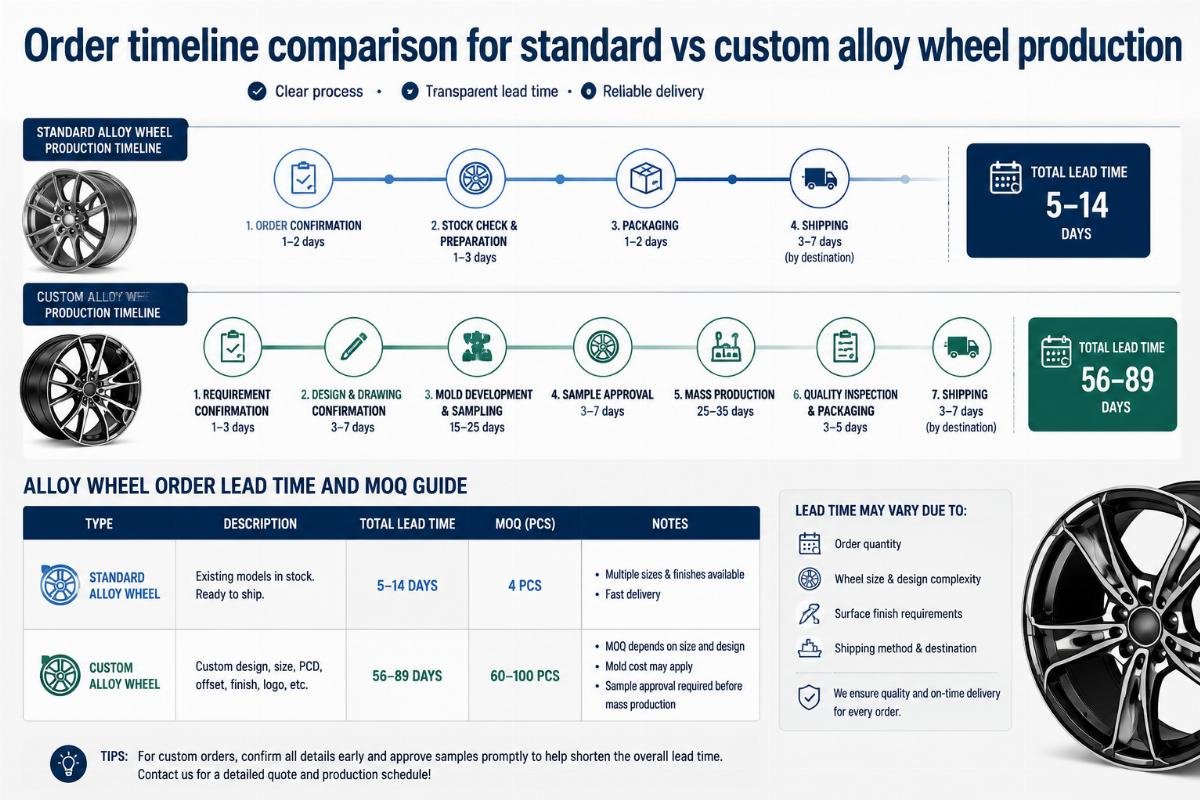
Standard stock alloy wheel models support 20-unit minimum orders with 15 to 30 day production lead times, while custom orders start at 100 units to accommodate small test and niche demand. The old assumption that custom wheel orders require minimum runs of 1000+ units and lead times of 45+ days does not apply to modern, scaled Chinese production facilities.
| Order Type | Common Misconception | Current Market Standard from Qualified Factories |
|---|---|---|
| Standard Stock Wheels | Minimum order requirement of 200+ units | 20-unit minimum order for all in-stock standard SKUs |
| Custom Design Wheels | Minimum order requirement of 1000+ units | 100-unit minimum order for custom paint, branding and design modifications |
| Production Lead Time | Standard lead time of 45+ days before shipping | 15 to 30 day production lead time for all standard and custom orders |
A European automotive modification and tuning shop placed an order for 35 units of custom concave alloy wheels last quarter, with custom paint and branded engraving requirements, and full production and delivery to their warehouse was completed in 22 days with no requirement to hold excess slow-moving inventory [NEED_CITE: Qualified Chinese wheel manufacturers support custom alloy wheel orders as small as 35 units for niche modification customers].
- Stock SKU Confirmation – Check the supplier’s public SKU list to confirm your required popular sizes are already in stock for low-MOQ restocks.
- Custom Order Terms – Confirm explicit minimum order requirements and lead time commitments for any custom modification needs before order placement.
- Shipping Alignment – Match production lead times to your standard sea or express shipping timelines to avoid unexpected inventory gaps.
How to avoid common risks when sourcing directly from Chinese wheel factories?
Pre-delivery quality checks, complete customs documentation and 3-year structural warranties eliminate 90% of common cross-border sourcing risks. Most of the horror stories about problematic direct sourcing come from buyers working with unvetted, uncertified small-scale workshops rather than established production facilities.
| Risk Type | Unvetted Supplier Outcome | Qualified Supplier Mitigation |
|---|---|---|
| Quality Defects | No pre-shipment inspection, up to 15% of units defective on delivery | Mandatory third-party or in-house pre-delivery quality checks for all orders |
| Customs Delays | Incomplete or incorrect import documentation | Full, verified customs documentation packages included for every shipment |
| Post-Delivery Issues | No formal support for defective or damaged units | 3-year structural warranty covering all manufacturing defects |
| Order Fulfillment Delays | No fixed lead time commitments, order delays of 30+ days | Binding lead time commitments with partial compensation for confirmed delays |
A US-based Amazon wheel seller we worked with last year switched from a domestic distributor to a direct Chinese manufacturer, and with pre-shipment

