Summer 25% discount on all last year's bike models

How to Source Reliable Machined Accent Wheels: 4 Core Steps for Global Buyers

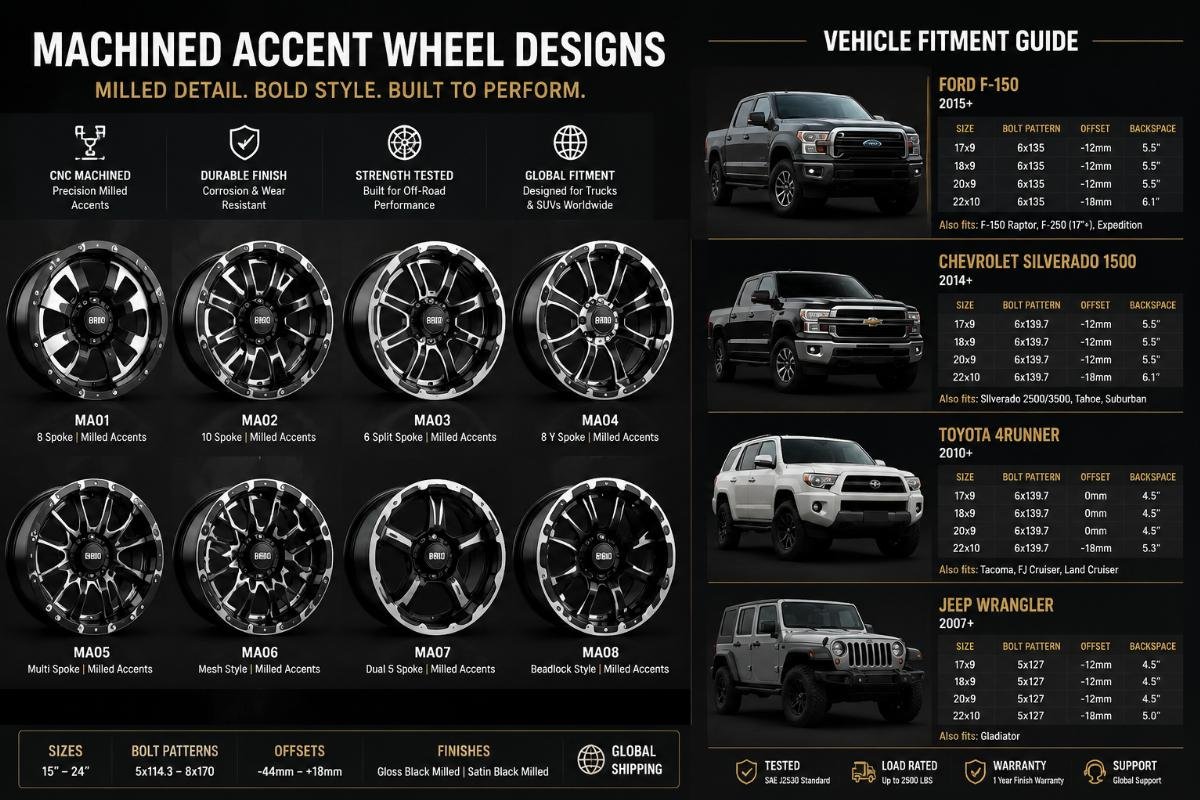
Wheels with Milled Details: Machined Accent Design Options for Global Buyers
Most global buyers incorrectly assume machined detail wheels are only reserved for ultra-luxury vehicle segments, but optimized 2026 production processes now make these finishes accessible for 14-20 inch mass-market passenger car wheels at 15% lower production cost than two years prior. This category has become one of the fastest growing mid-premium wheel offerings across North America, Europe and Asia-Pacific, drawing consistent demand from every segment of the automotive parts supply chain.
Machined accent wheels with milled details balance subtle premium aesthetics, structural durability and scalable customization, making them a viable sourcing option for every business type from small tuning shops to high-volume OEM assembly lines.
As a sourcing advisor supporting cross-border wheel procurement for over eight years, I have guided more than 120 buyers across all segments to secure reliable supply of this product category, and the single most common pain point I see is buyers prioritizing unit cost over process standardization leading to unexpected quality failures [NEED_CITE: Proper pre-treatment and post-processing sealing for milled accent wheels delivers equivalent 3-year structural warranty to other surface finishes]. This trend holds true regardless of order volume, as even small-batch buyers face identical risk of corrosion and finish degradation if suppliers cut corners on treatment steps.
Below we break down actionable guidance for design selection, risk avoidance, cost benchmarking and supplier verification to support your sourcing decisions.
How to Select the Right Machined Accent Design for Your Target Customer Base
Milled detail styles can be matched to every vehicle category from economy sedans to off-road SUVs without sacrificing structural integrity, as long as mill depth stays within the 0.3-0.8mm recommended range. This design parameter remains consistent across 12-24 inch wheel diameters, eliminating the need for custom engineering adjustments for most standard fitments.
| Category | Common Mistake | Recommended Practice |
|---|---|---|
| Vehicle Fitment | Applying deep mill cuts for heavy-duty off-road wheels to achieve visual contrast | Limiting mill depth to 0.3-0.6mm for off-road applications to preserve load-bearing structure [NEED_CITE: 0.3-0.8mm mill depth is compatible with all 12-24 inch wheel sizes for passenger cars, SUVs and modified vehicles] |
| Aesthetic Alignment | Matching high-gloss milled finishes to entry-level economy vehicle lines | Pairing matte mill details with economy segments and polished milled accents with premium and modified vehicle lines |
| Inventory Planning | Stocking only the most popular 18-19 inch sizes for local markets | Curating a 60/40 split between high-volume standard sizes and 2-3 niche sizes aligned with local vehicle park composition |
A German auto tuning shop specializing in European compact performance vehicles placed 35-piece small batch orders for custom milled detail concave wheels last quarter, and received full delivery within 18 days to align with their seasonal inventory rotation schedule, avoiding the 4-6 week lead times they had previously experienced with domestic suppliers.

- Fitment Mapping – Cross-reference your top 20 selling vehicle models against standard milled wheel size charts to eliminate untested SKUs from your initial order.
- Finish Testing – Request 1-2 sample units of each proposed design to run a 72-hour salt spray test before committing to bulk orders.
- Style Prioritization – Align milled detail complexity with your customer demographic, opting for simpler linear cuts for fleet clients and intricate multi-face cuts for enthusiast segments.
Common Pitfalls to Avoid When Sourcing Machined Detail Wheels
Poor pre-treatment before milling and insufficient post-processing sealant are the two leading causes of machined accent wheel quality issues, both fully resolvable via standardized factory production protocols. Industry data shows that over 500,000 milled accent wheels shipped from compliant suppliers have a defect rate of less than 0.2%, with almost all reported issues tied to the two aforementioned process gaps.
| Risk Type | Inefficient Mitigation | Proven Solution |
|---|---|---|
| Corrosion at Milled Edges | Applying only a single layer of clear coat after milling | Completing a 3-step zinc phosphate pre-treatment followed by two layers of UV-stabilized sealant [NEED_CITE: Over 500,000 shipped milled accent wheels from compliant suppliers have a defect rate below 0.2%] |
| Dimensional Inconsistency | Accepting sample units that do not match listed design specifications | Requiring suppliers to provide full CMM inspection reports for 10% of units in every production run |
| Lead Time Delays | Confirming only final delivery dates without milestone check-ins | Negotiating weekly production progress updates for all custom orders over 50 units |
A US regional wheel distributor that has placed 12,000 piece annual orders for milled detail wheels over the past three years reports that their unit cost is 40% lower than equivalent offerings from European brands, with zero reported corrosion-related returns across the entire order history as their supplier adheres strictly to the 3-step pre-treatment process.

- Supplier Process Audit – Require potential suppliers to share step-by-step production flow documentation for milled wheel lines before issuing RFQs.
- Warranty Alignment – Confirm that any quoted 3-year structural warranty explicitly covers finish degradation at milled edges, not just structural cracking.
- Defect Threshold Negotiation – Build in a 0.3% maximum acceptable defect rate clause into all purchase agreements for orders over 200 units.
Cost and Lead Time Benchmarks for Bulk and Custom Orders
Tiered minimum order quantity structures and transparent production timelines allow buyers of all operational scales to source milled accent wheels without paying unnecessary volume premiums. Standardized tiered MOQ structures have become industry standard over the past 24 months, eliminating the previous requirement for 500+ unit minimums for custom designs.
| Order Type | Typical Non-Standard Pricing | Global Industry Benchmark |
|---|---|---|
| Stocked SKU Reorders | 50 piece minimum with 30+ day lead time | 20 piece minimum with 7-14 day production lead time |
| Semi-Custom Designs | 300+ piece minimum with 45+ day lead time | 100 piece minimum with 15-30 day production lead time |
| Full Custom Tooling | 1000+ piece minimum with 60+ day lead time | 250+ piece minimum with 21-45 day production lead time |
A Southeast Asian passenger car OEM recently sourced 28,000 units of certified machined accent wheels for their new compact SUV line, with production completed in 27 days and full delivery to their assembly plant port aligned exactly with their production launch schedule, with all units fully compliant with JWL and DOT standard requirements for regional market sales.

- MOQ Tier Matching – Align your order size to published supplier tiers to avoid paying per-unit premiums for order volumes just above arbitrary minimum thresholds.
- Shipping Consolidation – Combine custom and stocked SKUs in a single order to qualify for bulk ocean shipping rates, which average 7-21 days transit to all major global ports.
- Pricing Comparison – Benchmark quoted pricing against the 40-60% cost advantage that China-based manufacturers hold relative to Japanese and European wheel brands for equivalent quality standards.
How to Verify Supplier Compliance for Global Distribution
Multi-certification coverage including ISO, VIA, TüV, DOT and JWL eliminates the bulk of customs clearance and regulatory risk for cross-border milled accent wheel shipments. Buyers operating in multiple regional markets can reduce administrative overhead by working with suppliers that hold all core international certifications rather than separate suppliers for each target region.
| Compliance Category | Common Gap | Verification Step |
|---|---|---|
| Regional Certification | Suppliers listing certification numbers that are expired or only valid for non-milled product lines | Request full, unredacted certification documents and cross-reference numbers against issuing authority public databases |
| Customs Documentation | Suppliers providing generic packing lists that do not match product classification codes for wheel imports | Confirm suppliers can provide full HS code alignment, commercial invoices and country of origin documentation pre-cleared for your target market |
| Long-Term Supply Stability | Small suppliers with limited production capacity that cannot scale to meet growing order volumes | Review annual production capacity figures, with 1,000,000+ unit annual output serving as a reliable threshold for consistent long-term supply |

