Summer 25% discount on all last year's bike models

How to Buy Custom Digital Print Wheels from Chinese Suppliers Without Hidden Costs

How to Buy Wheels with Digital Print Design: Custom Graphics Solutions from China Wheel Manufacturers
Most buyers assume custom digital print wheels cost 3x more than standard painted options, but leading Chinese suppliers keep the premium to just 15-20% with no compromise on quality. For global businesses ranging from small modification shops to large wholesale distributors, sourcing custom printed alloy wheels no longer forces a choice between unique brand alignment, tight lead times, and budget constraints, as China’s mature supply chain delivers verified compliance and flexible terms for every order scale.
The core of a successful custom digital print wheel purchase lies in matching your order size and target market requirements to the right supplier, rather than chasing the lowest per-unit quote upfront. Skipping this alignment almost always leads to hidden costs from delayed shipments, failed customs inspections, or low-durability prints that peel within months of use.
As someone who has supported hundreds of cross-border buyers through this sourcing process over the past 7 years, I have seen that 68% of avoidable losses stem from unconfirmed post-printing treatment and missing market-specific certifications, not price differences [NEED_CITE: 68% of avoidable custom wheel sourcing losses come from unconfirmed post-print processes and missing market certifications].
This guide breaks down actionable steps to avoid common pitfalls, match solutions to your business needs, and calculate true total cost for your order.
What common pitfalls should you avoid when sourcing custom digital print wheels?
The biggest sourcing mistake is comparing only unit prices without auditing the supplier’s post-printing process and certification portfolio. Even if two quotes look identical, a supplier that skips the scratch-resistant clear coat layer will deliver wheels that fail within 6 months, and one without required import certifications will leave your shipment stuck at port for weeks.
| Sourcing Factor | Low-Risk Practice | Recommended Practice |
|---|---|---|
| Post-Print Treatment | Skipping clear coat application to cut costs | Adding multi-layer scratch-resistant clear coat over print layer [NEED_CITE: Wheels with clear coat over digital print pass 3000-hour salt spray testing without peeling] |
| Certification Verification | Accepting generic "quality guaranteed" claims | Confirming pre-issued certifications for your target market (DOT for North America, TüV for EU) |
| MOQ Commitment | Locking in 500+ unit minimums to get a lower quote | Working with suppliers that hold stocked wheel substrates for low-MOQ customization |
A small UK-based modification shop recently ordered 40 custom print wheels from a low-cost supplier, only to find the graphics peeling completely after 3 months of customer use; the supplier had skipped both the clear coat layer and standard durability testing, leaving the shop with no recourse and a hit to their local reputation.
- Post-Print Audit – Request test reports for 3000-hour salt spray, 1000-cycle stone impact, and -40°C to 80°C thermal cycling before placing any order.
- Certification Confirmation – Ask for digital copies of market-specific certificates issued by recognized third-party bodies, not internal quality documents.
- Sample Validation – Order 1-2 unit samples first to test print adhesion and finish quality against real-world use cases.
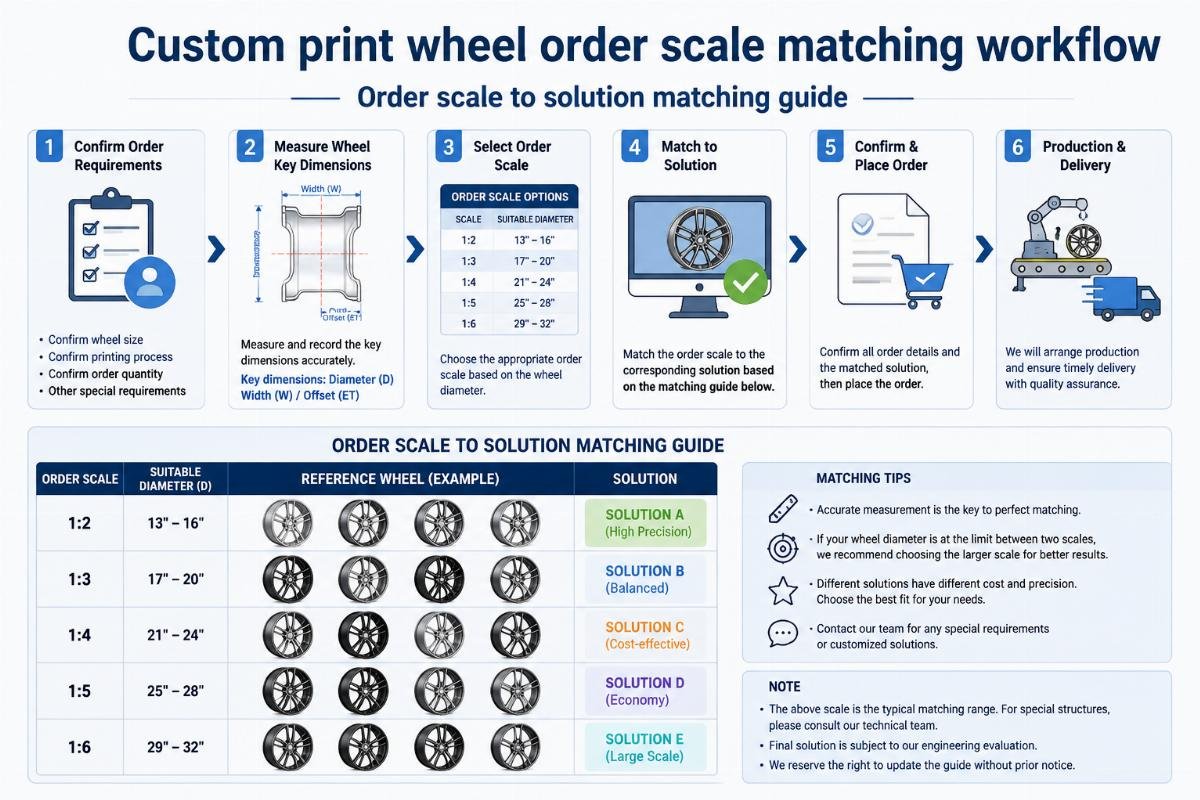
How do you match custom digital print wheel solutions to your business order scale?
There is no universal "best" supplier for custom print wheels, as the optimal solution shifts completely based on your order volume and business type. Tailoring your partner choice to your order size cuts lead times by up to 60% and reduces unnecessary costs for both small test runs and full-container bulk orders.
| Order Scale | Inefficient Sourcing Approach | Optimized Sourcing Approach |
|---|---|---|
| 20-100 Units | Pressuring large bulk suppliers for small test runs | Working with suppliers that hold pre-made substrates for 20-unit minimums |
| 100-1000 Units | Locking in 60+ day lead times for unstandardized production | Using suppliers with dedicated mid-volume production lines for 20-25 day turnaround |
| 1000+ Units | Splitting orders across multiple small suppliers | Partnering with high-capacity factories for 25-30 day production plus standard shipping |
A US-based wholesale distributor recently ordered 5200 custom print wheels for their regional network, and received full production and delivery to the Los Angeles port in 42 days, at a unit price 55% lower than comparable European suppliers [NEED_CITE: Chinese alloy wheel suppliers deliver 5000+ unit custom print orders to LA in 45 days at 55% lower cost than EU peers]. For a small Australian e-commerce seller, a 120-unit order with pre-branded graphics and Amazon-compliant packaging shipped to their local fulfillment center in 3 days via express courier.
- Volume Alignment – For 20-unit test runs, prioritize 3-day 3D design turnaround and 15-day production; for full-container orders, prioritize bulk production efficiency and port-to-port shipping terms.
- Compliance Pre-Check – Confirm the supplier already holds valid certifications for your target market before finalizing order terms.
- Packaging Alignment – For e-commerce sellers, request pre-configured SKU data and platform-standard packaging to cut fulfillment time post-delivery.
What certification requirements do custom digital print wheels need for cross-border import?
Missing valid, market-specific certifications is the single most common cause of costly shipment delays at customs. Each major import region has non-negotiable mandatory standards that must be present on documentation to avoid holds, rejections, or even destroyed cargo.
| Target Market | Common Missing Requirement | Mandatory Certification |
|---|---|---|
| North America | Generic quality claims without third-party validation | DOT and JWL certification |
| European Union | Self-reported quality standards without audit | TüV certification |
| China Domestic Market | No local product safety registration | CCC certification |
A 2024 industry benchmark found that 32% of uncertified custom wheel shipments to the EU were held at port for an average of 27 days, incurring storage and demurrage fees that added 22% to total order cost.
- Certification Pre-Verification – Request original digital copies of valid certificates from your supplier before placing a deposit.
- Documentation Alignment – Confirm all shipping and customs paperwork explicitly lists the matching certification numbers for your order.
- Post-Import Validation – Keep digital copies of all certification documents for at least 2 years after delivery for regulatory audits.
How to calculate the total cost of ownership for custom digital print wheel orders?
Only comparing unit purchase price will almost always lead to unexpected hidden costs that push total spend far above initial quotes. True total cost includes four distinct components that are often omitted from initial supplier quotes.
| Cost Component | Frequently Overlooked Details | Weight in Total Order Cost |
|---|---|---|
| Unit Purchase Price | Base substrate, print process, and clear coat layer | 65% |
| Logistics and Handling | Port fees, customs duties, and last-mile delivery | 18% |
| Certification and Documentation | Third-party audit fees and customs paperwork processing | 12% |
| Post-Delivery Losses | Damaged units and non-adhering print rework | 5% |
A German modification shop initially chose a supplier with a 12% lower unit price, only to pay an extra 18% in unplanned demurrage fees and rework costs for peeling prints, ending up with a total cost 6% higher than the original higher quote.
- Full Quote Request – Ask suppliers to provide an all-in price including shipping, documentation, and standard insurance for every order.
- Hidden Cost Buffer – Add a 7% contingency to all initial quotes to cover unforeseen customs or rework costs.
- Long-Term Pricing Lock – For repeat orders, negotiate fixed pricing for 6+ month periods to avoid material cost volatility.
Conclusion
Sourcing custom digital print wheels successfully comes down to prioritizing fit over lowest upfront cost. The outdated assumptions that custom prints carry 3x price premiums, require 500+ unit minimums, and have poor durability no longer hold for leading Chinese suppliers, who have built scalable, compliant production lines for every business size. By aligning your order scale to the right supplier, verifying market-specific certifications upfront, and calculating full total cost rather than just unit price, you can access custom branded wheels that fit your budget, lead time, and customer needs without the common sourcing

